Wednesday, June 16, 2010

The Weather Man


It really takes some skill for a movie to make us empathize with a man who, by all rights, is an absolute asshole. David Spritz (Nicholas Cage) is that kind of man. The Weatherman is that kind of movie. He 's misguided and selfish, lazy, dishonest, and distracted, but in the end not mean or malicious. It isn't just that he's the one who narrates the yarn that makes us feel sorry for him; we can see to a degree, where the decisions and mistakes he's made have taken him, and can hear the regret in his voice as he tells it. Beyond it all is a longing to make things better, even though he's completely misguided in his efforts.

Please note: Entries about media reviewed in this blog are written from the perspective that the reader has already seen the work in question and desires further commentary or explanation. Plot twists and endings will sometimes be examined.

The movie sort of starts in the middle of things. David Spritz introduces himself to the audience as a guy who's seperated from his wife and sees his kids occasionally. He's successful, we can tell by looking at his life, though all in all, we can see that he's also complacent and lazy.

He explains that his job doesn't really require very much work out of him, that despite the fact he ends up sitting around the news office for much of the time he's there, his paychecks are still very high. He's not even a meteorologist, he doesn't predict the weather, just provides a face for it. Because his face is well known from TV, sex comes easily to him without much work as well, but the drawback is that people often approach him too, and talk to him like they know him even when he wants to be left alone. In an ealry scene we see him wating in line at the DMV and get hassled by a fan who initially tries to be friendly with him until Dave lies to him about not being the weather man (the fan can see Dave's name right on the form he filled out and knows he's being lied to, demonstrating what an immature way it is to to handle the unwanted attention).

Every now and then people throw food at him too. Fast food only- he'll observe later, noting that it's something disposable they'd rather not finish, and that compared to the other sections of the news programs -which have more substance- he, himself as the weatherman is like fast food.

Despite having isolated himself from them with his attitude and demeanor, Dave's family still cares about him, though they are going through trials of their own. His daughter Shelly (Gemmenne De La Peña) is obese and unhappy and, as revealed by Dave's father (Michael Caine), is cruelly being called "camel toe" by the other kids at school. The first time I saw the movie I remember thinking "Man, is there anything Michael Caine can't do? Now he's explaining to a whole generation what a camel toe is in a dignified way. If only more people had seen this movie..." Dave's son Mike (Nicholas Hoult) is 15 years old and was recently caught with pot and now sees a counselor who has an unhealthy interest in him. His seperated wife, Noreen (Hope Davis), is now living with another man, Russ (Michael Rispoli) whom he openly dislikes. In an ealry scene Dave takes Shelly iceskating, who falls and hurts herself, and we see the way he bristles at this man who forcefully mediates between Dave and Noreen when she questions him accusingly "What did you do?" (though it's clear Russ only defends her when Dave tries to argue back). Dave is very juvenile in behavior at times and it shows when he responds to their criticism at cursing by doing it even more to spurn them on. More trying than anything else however, is the situation with Dave's father, Robert, a Pulitzer Prize winning author who it is revealed early in the film has lymphoma and will probably die in the very near future. Dave is ever trying to impress this man who's shadow he's lived in his entire life. When offered an interview for the weather man position at "Hello America", a national TV show with Bryant Gumbel and significant step up from his current position, he childishly sets it on the passenger seat when picking up his dad to try and get him to notice (Robert sits right on it).

Robert wants his son to be more mature and responsible. "The right thing to do and the thing that is most difficult are often one and the same. Easy doesn't enter into grown up life" he tells him at one point. We hear Dave's thoughts as he sorts things out and yearns for a way to make his father proud. "Don't die yet Dad, let me pull things together. I can make things work with Noreen and the kids and get this 'Hello America' job." We can see that he misses his old life because he occasionally sits in his car, parked outside the house he once lived in and stares in silence at it. His longing to make things better is clearly there though we'll soon see exactly how screwed up his attempts are.

He and Noreen go to couples' therapy hoping to reconcile to some degree. While there, the two of them are told to write something they've never said before but always hated about the other on a piece of paper and give it to them. And then never read it to build trust. Dave breaks this promise before the therapy session is even over and reads the note in the bathroom (she hated his attempted sci-fi novel, which looks to us in the audience more like an effort to impress his dad than anything else). When Dave confronts Noreen about what he's read, she is furious with him for breaking his word and the fight they have afterwards ends in shouting and cursing.

Aside from the fast food that makes it's way at him from time to time, another tangentially related detail to Dave as a character in the movie is archery. It starts originally as an activity Dave tries out with Shelly to bond with her, though she almost immediately loses all interest in it, leaving him the remaining lessons in the package he bought her. He begins doing it as a solitary way to spend time and quickly finds it helps him by providing focus which is lacking in his everyday life.

A trip to New York for Dave's "Hello America" interview and a second opinion on Robert's condition starts off promising when Dave tries talking to Shelly about the "camel toe" teasings. When he asks her if she knows why they call her that, she replies "Cause camel toes are tough. They can walk all over the desert without getting burned." Seeing that the mockery she is getting is actually giving her strength (about as good of advice as any parent can give regarding bullying), Dave decides not to tell her what it really means and instead opts for the different approach of buying her a new wardrobe which is largely is comprised of dresses. However, things turn sour very quickly when Dave receives a phone call informing him that Mike has been arrested for some trouble with his counselor (who it's said molested him), and Robert's diagnosis comes in confirming he will die in only a short time. Dave spends the whole night up drinking and brooding and the sense of dread that he'll fail this interview seeps in. The next morning, however, he does surprisingly well and leaves his interviewers impressed. I really liked an interchange he had with Bryant Gumbel (played by himself) in this scene. When asked if he's nervous he simply says "no". "You seem nervous", Gumbel follows up, and when Dave replies simply "I'm not nervous", "Other stuff then?" Gumbel confirms softly. So much is left unsaid yet we understand it all. The movie does let us know that, even if he's not a meteorologist, Dave is fairly good at his job which requires a sense of space, timing, and improvisation as well to deal with a green screen. I sometimes wonder if it was because of sorrow over his father's diagnosis that Dave did well in the interview. Perhaps he was more honest than usual? Even if we're sad or hurt at least the honesty makes us more vulnerable and allows others to look closer in.

Dave returns home and promptly confronts Mike's counselor by punching him in the face and threatening him before returning to his son. Shortly after that Dave is offered the "Hello America" job but, depressed and apathetic, doesn't accept immediately leaving the audience to wonder if this will get screwed up as well. Then comes Robert's "living funeral", a gathering of family and friends to give everyone a chance to say how they feel about him before he passes on. Dave tells Noreen about the job, and asks her if she'll give him a second chance, feeling they and the kids could go to New York and start over again. But Noreen instead tells Dave she's decided to marry Russ, crushing his hopes for reconciliation once and for all. Dave goes out for target practice during a break in the proceedings, and we can just feel his pain and anger as he even takes aim at Russ at one point in this very tense scene. Next comes another wrenching moment as Dave's turn to speak to the crowd about his father gets ruined when the building loses power just after he starts his speech. It's almost like the final insult fate could throw at him at this point; he's just been completely robbed of a chance to say something kind or inspirational about the father he'll soon lose.

But then a few days after the whole ordeal is over, Dave is stopped by Robert for a quiet talk in his car. Robert asks Dave about the opening part of his speech (which involves a Bob Seger song), showing that he was really paying attention to what Dave was saying. Things get emotional as Dave tells his father about the job offer but then breaks down in tears when he reveals what has happened with Noreen. But Robert tells Dave he's proud of his achievements as a weather man, landing such a high position and also reveals to him part of why he's successful as a writer (he knows about and has read Dave's novel); he says simply that he just kept doing it until he got good at it, but that it took years to do. It's an important scene, giving the two of them a final sense of closure.

The movie concludes with Robert's funeral and Dave's narration telling us that he accepted the job and moved to New York. He appears to have made peace with who he is and how things have turned out. All the possibilities for people he could've been gradually got whittled away as he got older, he explains, until he ended up the person he is, the weather man. He still returns to Chicago, seeing his kids on the weekend in visits. He also continues his archery, and no longer gets food thrown at him, though he jokingly wonders if it's because he now carries a bow around with him. The closing shots are of him riding a float in a parade with Bryant Gumbel and the others from his show. "I'm behind the fire brigade, but in front of Spongebob" he observes, juxtaposing his earlier conclusion that he was "fast food".

* * *

Throughout the film, themes of maturity are discussed as we look at this character who has somehow managed to dodge responsibility and still become "successful" in life, if one could call it that. Dave might have coasted by in life as long as he has, but that he is a disfunctional person as the film starts is evident as we watch things catch up with him over the course of it all. The film demonstrates quite effectively that financial security doesn't necessarily spell success by showing us how a man like Dave, who should have everything going for him, is instead faced with problems of a different sort. Money cannot buy happiness, and that the walls in Dave's life are beginning to tumble down really show it.

"Easy doesn't enter in to grown up life", Robert says at one point, and Dave repeats it at the end as the sort of lesson he's learned. It would seem to be the movie's message to us, though I took something else away from it as well. Regardless of whether we're smart and accountable or oblivious and lazy, the rain falls on us all in the end. And life is as unpredictable as the weather.

Tuesday, June 15, 2010

The Journey of Shuna

Originally published in 1983, Hayao Miyazaki's The Journey of Shuna is an early work that very much provides a glimpse at themes and concepts the artist would eventually flesh out to a greater extent in future works "Nausicaa of the Valley of the Wind" and "Princess Mononoke". In many ways it feels almost like a rough draft of those later two works. It is short, done entirely in watercolor, and almost never even uses captions, instead sprinkling what little dialogue it has amongst descriptive sentences that give it the quality and feel of an old story book rather than traditional manga.

Please note: Entries about media reviewed in this blog are written from the perspective that the reader has already seen the work in question and desires further commentary or explanation. Plot twists and endings will sometimes be examined.

The story begins in an isolated valley whose inhabitants work very hard to scrape an existence out of the soil. They raise livestock as well, but due to the difficulty of life, their numbers dwindle, with members of the younger generation growing smaller. Shuna, the prince of the small kingdom, is looked up to by the people and feels a great responsibility for them. He one day happens upon a dying traveler who tells him of a strain of golden wheat that could greatly ease his people's suffering, but the grain lies beyond the uncharted wastelands to the west. Deciding he must take the chance to try and find the grain, Shuna prepares some supplies and a gun and heads off to search for the grain.

From the very beginning, the story has elements in common with other Miyazaki works. The valley setting resembles Nausicaa, and the early scenes from this book recall those of the village from Nausicaa's valley of the wind. Shuna's mount is named Yakul, the same as the red elk Ashitaka's from Mononoke, and the two are more or less identical in appearance and demeanor. The journey west, as well mirrors that of Ashitaka's.

Shuna travels over deserts, mountains, and canyons devoid of life, before these sights make way to forgotten ruins and signs of civilization. He comes across an enclave of female cannibals who try to lure him in before he becomes suspicious of them and flees, only to have to fight them off later when they pursue. He then makes his way to a large, walled free-city full of slave markets and traders. The idea that civilization is corrupt and wicked is demonstrated very well in these scenes. The rotting alleys and starving slave children lie in plain sight of the rich and opulent. An unscrupulous merchant tries to sell Shuna a pair of young girls, claiming they are actually deposed royalty, only to have the elder of the two, who is named Tea (pronounced Tay-Ah, not tee), expose him for a liar right in front of Shuna to the fury of the merchant. Later Shuna laments his feelings of powerlessness at it all. He could sell his gun or Yakul to buy the two girls, but where would it leave him but powerless to defend himself from opportunistic others? He was already warned not to by the girls.

And so he instead makes his way outside the city to camp where he is approached by an old man who gives him still more information on the golden grain he seeks, in exchange for food and the warmth of his fire. The old man tells him that the golden grain can be found in a place he calls "the land of the gods" and that he'll reach it if he continues west to a great precipice and then to the land where "the moon is born and returns to die". The following day, Shuna resolves to free the girls he met earlier by force, and launches a surprise attack on an armed slaver's wagon. The three then flee from the vengeful slavers.

Knowing that they will eventually be overtaken because Yakul is slowed down by the burden of carrying three instead of just one, Shuna gives Yakul over to the girls and then prepares to wait for and ambush the band that is after them. A fight ensues, and Shuna is able to overcome his aggressors, but as the fight ends he sees a large luminous object float across the sky and sink into the hills beyond a canyon in the distance, "the place where the moon returns to die..."

Shuna climbs down shear rock cliffs, past ruins lost in time and the giant bones of extinct beasts to a violent ocean. He falls asleep exhausted only to wake in gentle waters which are now shallow enough to wade across. He sees prehistoric creatures of enormous size swimming in the waters and wandering in ancient forests he encounters beyond. These scenes are very reminiscent of ones in Nausicaa's "Sea of Corruption" and Mononoke's glade of the Forest Spirit. All of these places give the sense that they are untouched by man, untamed and wild but also pristine in this sense as well.

Finally, Shuna comes to a strange valley filled with giants who appear to be the gardeners of this bizarre land. At the center of it all is a large otherworldly structure that upon closer inspection appears to be alive. At night the giant floating "moon" returns to drop the bodies of people into this structure, leading the reader to believe this land is fed and fertilized with human lives. This part of the narrative is very similar to that of the hidden valley and ancient pyramid in the center of Dorok from Nausicaa. It is beautiful and appears fruitful, but hides a sinister aspect which is key to its prosperity, the corruption at the center of the fruit.

Shuna plucks some of the golden grain he finds there, only to discover the entire valley seems to know he has done so the instant it occurs. The giants shriek and howl and a strange, frightening, unnatural pain pierces Shuna and seems to follow him as he runs back through the forest. When he comes once more to waters, however, he discovers they have again returned to a raging storm of oceans. Trapped and with nowhere else to run he jumps into the torrid waves...

The story then shifts perspective to Tea and her sister, the two slave girls who escaped earlier thanks to Shuna. The two now work very hard under the harsh and demanding servitude of an old woman in a small village. One night, feeling uncomfortable and sensing the same in Yakul, who still remains with them, Tea wanders out into the night to find none other than Shuna, tattered and disoriented and ambling aimlessly in the wilderness. Tea takes him in only to discover he now appears to be mute and also seems to have little or no memory of the past. Despite the burden he has become, Tea continues to care for him, nursing him back to health and planting the seeds he carries in a pouch he had on him, to be harvested next season.

Meanwhile, the old woman Tea is working under has become impatient with her and the burdensome Shuna, whose mind is shattered and is too shellshocked to work with the girls. She demands the girl marry and whole village shows up to a gathering designed for the occasion. Though we have seen her loyalty to Shuna, it is at this point that Tea shows some ingenuity of her own as well, by choosing carefully the conditions of the test her new husband will have to pass. The test she puts forth is that the one who can ride upon Yakul, who becomes rebellious and fiercely shakes off anyone who tries to mount him, will be the one who takes her hand in marriage. It is a test that all the men in the village fail at, until Shuna, still speechless and weak approaches the beast who becomes immediately calm in the presence of its former master.

From here the story proceeds a bit more easily. Tea and Shuna are married, and eventually Shuna recovers his speech. The two continue to grow and harvest the golden wheat, expanding the fields and prospering while fighting off threats from outside. The story ends as the day comes when Shuna, Yakul, Tea and her sister pack their things and get ready to head back to Shuna's hometown, thus beginning yet another journey.

* * *

In addition to the aforementioned similarities it has with other Miyazaki works, The Journey of Shuna also has an affinity with several ancient myths and folktales. Shuna traverses a large expanse of land and colossal sights of nature, through deserts, across oceans, and into chasms, to see things few others ever have. I'm reminded in some ways of epics like those of Gilgamesh and also Odysseus and (in a more recent example) Conan the Barbarian who also took unbelievable journeys.

The struggle of Man vs Nature (a common motif in Miyazaki works) is in this story portrayed more as a natural strife than a direct, literal conflict between the two, with only the section of the valley of the gods having any kind of supernatural aspects to it. For the most part the Man vs Nature struggle is demonstrated by the characters clawing away at the soil to survive with only moderate success. The desperation of the land they inhabit is what fuels the slavery and persecution that plagues it. And so the cruelty of human nature makes it appearance (another trait common to Miyazaki's work, especially Nausicaa's depictions of war).

The way Shuna takes the grain is very much like Prometheus's stealing fire from the gods, or instead of the Apple of Eden being picked by Adam and Eve, we have here Shuna picking the wheat. Man's prosperity is seen as being very much an endeavor of taking an advantageous item from gods who are controlling or oppressive.

The final part of the story owes much to the fairy tales of the more recent past like the Brothers Grimm as well as fables and parables like those of Aesop. Strong female characters are another hallmark of many Miyazaki works and centering in on Tea, the tone of the story shifts very much from one of action, adventure, and exploration to one where the girl's wit and determination are necessary for success, being that this girl doesn't break/fight convention by simply acting like a boy. The test she puts her suitors through at the end is evocative of tests in other fairy tales like the glass slipper in Cinderella, Arthur's Sword in the Stone, and the countless times we've heard that only a kiss from the true and destined person will break a particular curse. Unlike those examples, however, no magical hand of fate is involved on the protagonist's behalf, causing them to rely instead on their intelligence to think through the situation and bearing more in common to the test facing Chihiro at the end of Spirited Away, another Miyazaki work.

Other elements of fairy tales include the original story to Shuna by the dying traveller and later the old man who helps him, demonstrating a character shunned by nearly all in society, but who actually has useful knowledge to be given to the main character when they show that person a rare kindness.

Shuna could be an interesting little supplement for those who like Miyazaki, or could possibly serve for those who are interested in a quick introduction to his work. I'm not sure if this has been published in English or not, but it's a fast read at only about 150 pages, and comprised more of images than words, also making it a good choice for those studying Japanese and want an exercise that isn't too daunting.

Shuna and Yakul in the free-city

The three fleeing on Yakul

The slavers in pursuit

The ancient forest

The strange fortress in the valley

The three heading home

Tuesday, June 8, 2010

The Hills That Watched Me Grow

As a teacher of Japanese school kids I sometimes find myself telling them about my life back home. A recent story I told some of my classes about school in America and its differences with school in Japan turned to something more when found myself suddenly bombarded with a ton questions about the details of my childhood in southern California. The whole thing left me grasping for memories that had long since flitted away in different directions like birds out of a cage suddenly free. Of particular interest to them was how summer vacations played out in the US since it lasts a full month longer for the kids in America (kids in Tokyo are only off the month of August and for a few weeks in the end of July). It's June now and with the American summer about to begin, I find myself waxing nostalgic about the life I had that once was.

Summer vacations in my hometown of Santee were long and slow and lazy. My parents sent me and my brother and sister to summer school a few times to keep us busy and because there weren't enough kids to make a full school several districts were combined and we occasionally were bused to other elementary schools to mix with other kids from Hill Creek, Rio Seco, Pepper Drive. Summer school always ended in August anyways and so even with it, we kids found ourselves with a ton of time on our hands. Daytime television was boring as hell and so we ended up geeking out on video games for SNES and Genesis far more than was healthy. RPGs took up whole blocks of my break. Mostly the ones by Squaresoft. Also hanging out at our neighbors' place playing Street Fighter II and listening to his old hip hop CDs. Snoop Dogg and Warren G were really popular back then and the West Coast was becoming known for its sound (the creation of G-Funk). It kills me sometimes to think of how many white, asian and mexican kids living in the suburbs of southern Cali would sit around watching Boyz N the Hood and Menace II Society. We shot hoops during the day when it wasn't too hot and occasionally played games of street football in the afternoon or early evening when things had cooled down. We'd drink beers bought by someone's older brother, or alcohol taken from the liquor cabinets of friends' dads and other times spent the day sitting around playing cards with MTV or Jammin Z90 on in the background. We were mostly too poor to buy CDs, that or just about always seemed to want to buy video games with the money we'd saved up and so MTV or the radio was just about always on to give us something to listen to.

Our bikes gave us mobility and we sometimes didn't know where we might end up going when we set out over the course of a summer day's lackadaisy. We'd head out to town center, to Santee Lakes, and sometimes all the way down Magnolia Ave to Wunderland, the nickel arcade, where we'd spend hours (and tons of nickles) on games like Samurai Showdown and Alien vs Predator. In and Out Burger was there too, still just about my favorite when it comes to fast food, and one of the places I miss fiercely now that I call Japan my home instead of Cali. That and good, cheap Mexican food on every corner.

Candybars may have cost a nickel when my parents were young as they so often liked to remind us, but back when we were kids three for a buck was about the best we could do and you had to bike to the drugstores like Long's on a hot summer's day for it though you usually had to eat it there or it'd melt some before you got home. Thrifty's on Cuyamaca and Mission Gorge had really cheap ice cream which I'd learned long ago when I was little and realized that my mom I would buy it for me almost everytime I went running errands with her that took her to that store.

It was also at drugstores that you usually found comics. We'd read as many as we could before we either got bored or were given sharp looks by the storeclerks telling us it was time to leave. I think it was in an actual comic store, however, that my brother and I first discovered manga and a love for the new and different form took hold in me. From it I suppose you could say sprung my interest in Japan and ultimately my desire to see it firsthand. Funny how one thing can lead to another...

My little brother built a treehouse out in the unclaimed area behind Rio Seco. It was mostly made of tough, black netting draped between the large boughs and then pinned and tied on super tight to hold our weight. Oh, and old boards nailed up the trunk to give us a ladder to climb up. It was like a set of large hammocks to relax in. We got high in those branches a few times while hanging out and wasting time.

Not far from our house is a series of rolling hills that used to be a quarry for mining or something like that long ago. Santee has changed a lot from when I was young, there used to even be some stables and horses there on some of the properties when I was a child. Even at that time those little "ranches" (if you could call em that) were really starting to dwindle. We used to go hiking in those hills when there was nothing else to do. It was my dad who first introduced my brother and I to it. We would go on weekends up those big and dusty mounds covered with brush and dried out shrubbery and large white boulders some of which had been sprayed painted up by others. We hiked up the hills and climbed up the rocks, scurrying and jumping gaps, and learning how to gain footholds and grab handholds with our fingers to pull ourselves up. The rocks came in all shapes and sizes and my little brother and I gave silly names to all of them (many of them after which of our favorite cartoon characters they reminded us most of, mostly Disney characters or GoBots). I remember in the beginning the big one we would go to, we called "Mickey Mouse Rock" because it was two large boulders on an even larger boulder and the way they were set kind of reminded us the famous mouse ears. If you sat between those ears you'd get a nice breeze that blew over the valley up the hill and whistled between the two rocks. It also gave you a great view of Santee including where we lived at the time and Cajon Park, the elementary school we went to. Other impotant ones were Blue Rock which must've had a half a hundred coats of paint on it (all by various passersby over the years) before it ended up being the color which gave it its namesake. And finally there was "Boot Rock" which we'd named for it's shape. It was the one nearest the old quarry with its hundreds of abandoned shards of stone laying scattered and stacked unevenly about like the gigantic wooden toy blocks of some long forgotten colossus. You could still see the grooves in the old stones where those who'd worked the quarries before had drilled the holes to put in the blast caps and break the stones aparts. I used to go up there with my friends and we'd play hide and seek in those piles of old blocks. If there was one thing that place provided, it was a lot of good places to hide though we found after a while that it was easier to catch people by listening rather than looking. The sounds of nature were all around but the rustle of loose gravel and echoing of footsteps was easy to hear.

I remember hiking up there with my little brother and Dad one spring after some heavier rains and stumbling onto something which has lived on long in the fuzzy memories of my childhood. In a deeper puddle of water left by the rain runoff we found some tadpoles and even some frog eggs with the little black creatures wiggling round inside them. My dad, perhaps sensing an opportunity to teach my brother and I something about nature, suggested we return with jars to catch some of them so we could watch them grow before returning them to the hills. We did so, and returned each year when the seasons changed to collect the little froglings in old pickle jars and applejuice bottles. "Polywogs" we used to call them and I still remember many a morning spent crouching down on a little shard of rock catching them in the "Big Pond" and "Little Pond" as we called the two places we most often could find them. If it was my dad's plan, it worked, and we did indeed learn a few things about nature by catching and watching them. We learned what they ate, what they looked like as the grew, and that when animals in the wild that have a lot of offspring all at once, only the most robust tend to live to maturity, even with a safe environment to grow in.

I first moved out during my years in university and found myself spending more and more time driving to the beach and surfing since I now had access to a car and lived closer to the shores than before. I'd drive home to see my mom and dad, occasionally do my laundry, and use the computer and burn CDs out of mp3s I'd downloaded, though I sometimes wonder now if this wasn't more just an excuse to go back and visit. I'd watch the Simpsons with my brother and sister if they were around or stay for dinner if it was late enough. My friend Phil said it best when he told me that at first the house you grew up in will seem like it's always been, but that gradually it simply ceases to be your home.

The first time I left California was in 2003. I went to Florida. I came back after several months when things didn't turn out quite as expected, and then lived in San Diego for a little over a year before deciding to come to Japan since Phil had moved here a few months earlier. I've been here for over four years now.

Living away from home during college I noticed how much faster things changed each time I came back home: a new building here, a shop closed down there. Nowadays when I return I see the changes happening by leaps and bounds with each turn since it now occurs only seldom over a matter of years rather than weeks or months. The one thing that never changes is the hills around my hometown. I'm sometimes reminded of the Chili Peppers' song "Under the Bridge" and he way Anthony Keidis refers to his city as an entity that can see and empathize with him. If there's ever been a place I've identified with it's them, the hills that surround my hometown. As I got older I found myself visiting them less and less over the years. We'd still go hiking up there every now and then with beers or bottles of alcohol and we'd get drunk or get high while chatting and looking out over the little city that raised us. At night we could see the lights of Santee shining like a puddle of stars that had spilled into the valley, interupted only in the areas where the hills rise out of the ground by the blackness that is nature at night, devoid of manmade light. The last time I came back to Santee was last summer, 2009 to see my friend Josh get married. That was the last time I visited the hills that watched me grow. Each time I go up it surprises me to see the way the urban sprawl of the city keeps slowly creeping up the sides of the valley, coming ever closer to the quarries and the rocks I climbed as a child. I wonder sometimes if it'll ever all get cleared away to make room for more houses.

It's not that I long for the past so much as treasure what memories I have been able to have. I know that things change and we can't go back, it's what makes the past so stirring and for that same reason the times we live in now so exciting. There's only one now. And things will never be same.

The hills surrounding Santee

Topmost on the hill: "Mickey Mouse Rock"; you can see how the two smaller boulders on top make sort of like "ears"

Mickey Mouse Rock up close

The view from between the ears, you can see the school from here


Blue Rock

It's in the shell created by these shards of rock that the water collects like a bowl after the rains. We called it the "small pond" next picture as well.


A bunch of rocks and dirt had fallen into where the small pond was when last I went up there to see it

The old quarry in front of where "Boot Rock" sits.

Boot Rock closer up

The quarry we'd hide in

Boot Rock over-looking the city

Sunday, June 6, 2010

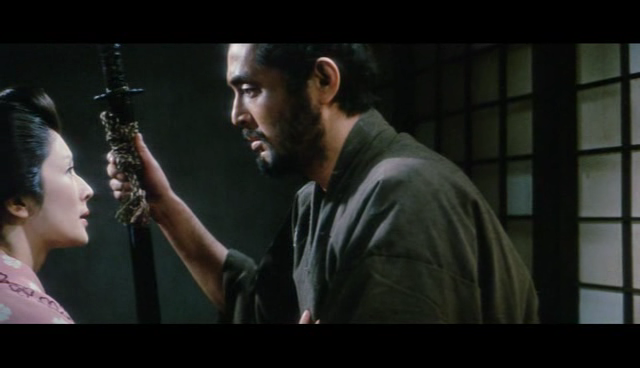
The Warrior Spirit: Hideo Gosha's Goyokin


Released in 1969, and today known mostly by only those with a special interest in samurai flicks, Goyokin is one of the standouts of the genre. It has several well-coreographed fight scenes, and stunning imagery from the technicolor era, but the acting and plot (which bears several shades of resemblance to "Ninja Scroll" for those who are anime fans) haven't been neglected either. It's just dramatic enough to make us care but still a manly enough story to rouse us when the main character, Magobei, decides to confront the demons of his past, even if it means opposing the clan leader he once called a friend and all the man's soldiers as well.

Please note: Entries about media reviewed in this blog are written from the framepoint that the reader has already seen the work in question and desires further commentary or explanation. Plot twists and endings will sometimes be examined.

The movie opens with an explanation of a how certain capital bound ships loaded with gold would regularly make their across a perilous stretch of ocean to their destination. Next we watch as a young woman named Oriha (Ruriko Asaoka) returns to the small fishing village she came from only to find it deserted and dilapidated. The scene proceeds for quite some time without any music or even dialogue and is a bit eerie in feel. Everyone in the village has mysteriously disappeared, "kamikakushita" as the Japanese put it, which Miyazaki translated as "Spirited Away" (Sen to Chihiro no kamikakushi, literally Sen and Chihiro's spiriting away), but is translated in this movie instead as "taken by the gods". Darker words for a darker story.

We then cut to a scene of feudal era Edo three years later. Our main character, Magobei (Tatsuya Nakadai), is introduced as the equivilant of a carnival samurai. Scraping by a living by showing off his swordsmanship to passersby at a festival. We will learn shortly that he's entered a self imposed exile, that something bad happened in his past which has brought him to this point. He is broken and appears to have had the fight taken out of him. He even appears ready to sell his own sword. "What honor is there to being a samurai?" he quanders when asked if it means he intends to quit his profession. Magobei does, in the end however, change his mind and keeps his sword, and just in time it would seem too; he soon finds himself surrounded by armed men come to kill him. We see quickly how skilled a swordsman Magobei is watching him handle the would be assassins with little trouble. He offs four or five men in seconds and then exhales like a man who's gone without breathing for three years. He is given much pause, however, when he learns that these men are from his former clan and the reason they've come to kill him.

A flashback shows us what pushed Magobei to quit his clan in the first place; the members of the tiny fishing village who were "taken by the gods" three years earlier were really killed upon the order of Magobei's clan leader, Rokugo (Tetsuru Tanba) who did so in order to steal the gold of one of the official ships, which passed through waters nearby, and conceal the evidence. Magobei left the clan voluntarily to avoid fighting with Rokugo, who not only is his leader but also the brother of his wife. It is clear he disapproves of Rokugo's decision. Though he makes Rokugo promise never to do so again, Magobei learns from his former clan mates come to kill him, that the man intends to do just that. And so our lone samurai vows to return home to confront the man he once respected despite the large number of warriors at his command and his relationship as a brother-in-law.

At this point we are also introduced to the other characters in the story. It is revealed that Rokugo's second in command, Kunai (Isao Natsuyagi), was the one who ordered Magobei killed, and that he did so without Rokugo's knowledge or consent. Kunai is a slippery, sinister man who unlike Rokugo doesn't have reasons to want Magobei spared, and feels that killing him is the safer course of action. We meet Shino (Yoko Tsukasa) as well, the sister to Rakugo and wife to Magobei, who gives the two of them pause to fight with one another. She is sent, early in the film, to go see Magobei in (we shall learn later) an attempt to dissuade him by different means. The young woman from the beginning of the film reappearsb as well. Though being something of a tragic character, having lost all her family and friends, she's actually very feisty in behavior; when we see her again she is working at a gambling house and attempts to cheat a group of yakuza at dice with an accomplice, Rokuzo (Ben Hiura) a young man she appears to have met over the years. Their attempt fails and they end up running away only to be surrounded. Perhaps in an attempt to try and scare the men away she calls herself, "Oriha, Taken by the Gods" (although forgotten by the gods might actually have been more appropriate given she was left behind). Magobei, who by chance happens to be passing by (in one of those coincidences that only seems to happen in the movies), overhears her part of her story and saves them from the angry gamblers. Tearfully, she later tells Magobei that she was away from the village working to save money for a wedding kimono, which Magobei knows was later used in a decoy wedding procession to get the villagers away to a deserted place to be slaughtered. It turns out, however, that Oriha is attempting to get more information out of Magobei for Samon (Kinnosuke Nakamura) the last of the film's major characters, a shadowy government spy who's good with a sword, but working alone.

Things proceed from there as Magobei makes his way to a confrontation with his old clan. There's fight in the rain in a run-down, abandoned mountain town where Magobei gets forced into a house his opponents set to fire, though in the end he's able to escape thanks to Samon. Then comes perhaps the most pivotal scene in the film as Magobei meets with his wife, who begs him to leave it behind and come away with her. She clearly is worried that he'll die, and tells him she has some money saved up and that they can make the beginnings of a new life with it. Magobei sees right through the situation, however: "Rokugo gave you that money, didn't he? This is his attempt to bribe me to close my eyes once more." The scene is important because it shows our main character's resolve. It reveals things about his psyche that he doesn't share with any of the other characters. He feels he compromised his honor once before by closing his eyes, and refuses to do so again.


As I mentioned once before, the plot to this film resembles that of the anime "Ninja Scroll", with its plot to steal gold from a ship passing by. Magobei is able to figure out that Rokugo plans to sink the government ship by placing warning fires in incorrect positions to run the ship aground, afterwards using the "Taken by the gods" routine once more. Together with his companions, Samon, Oriha, and Rokuzo, Magobei is able to thwart Rokugo's plan, saving the villagers, allowing the ship to pass safely by re-lighting the correct fires, and demolishing Rokugo's soldiers in process.

The final showdown is a stunningly shot duel in the snow between Magobei and Rokugo. Watching it we feel the emotion between these two men. The mutual respect that once was, but has since turned into contempt. We realize that these two men have absolutely destroyed one another. Rokugo by shattering Magobei's honor, Magobei by ruining Rokugo's plans.


* * *


Goyokin is not a great film, but it is a memorable one, and it's easy to see why it's considered a classic within its genre. Many of its elements may appear to be simply adequate, but the creators made a lot of intelligent choices which add up to something more than just another well done samurai flick.

The plot is good, functional as a vehicle for some great fight scenes, but not without an emotional center either. We never doubt that the main characters are motivated by realistic desires, whether they be ambition, revenge, or redemption. The characters are good as well: Magobei, Rokugo, and Shino provide the serious elements, Samon is sly and cunning, but humorous also, and together with Oriha and Rokuzo (the two of whom remind me a little of Hyakurin and her bumbling sidekick from the "Blade of the Immortal" manga) help round out the comedy relief. Nor are the characters one sided either. Rokugo is more than a one dimensional villain, being that he despises the greed of the shogunate he's subjected to, and actually wants to improve conditions for his clan, even though his means, it's hard not to argue, seem selfish and cruel. He honestly believes he's acting with the best interests of the clan in mind. His attempts not to hurt Magobei too, show a sort of respect for the man even when they find themselves opponents.

The acting is uniformly good as well with the main character Tatsuya Nakadai as Magobei being the real standout. I remember reading or hearing somewhere once about the Indian actors and that what made them so amazing was the way they "acted with their eyes". While I'm not much a judge on Indian cinema, I do have to say I thought that Nakadai had something of a similar quality in this film. His eyes are always intent, focused, and reflect the unrelenting nature of the character. He is completely and totally driven. "What is he looking at?" I find myself thinking. There's pain and a sadness there too, as well as a regret which we know is for things unchangeable. And finally perhaps a trauma that comes from seeing things that would drive any ordinary man off the deep end.

Finally there are a lot of little details that really help propel the film beyond the usual fare common to films of this type. Beautiful cinematography: bright red blood on snow, a storm of crows in the sky getting ready to feast after a massacre, the men in masks hammering away at drums in the final scene. I liked the look that passes between Orhia and Magobei before he continues onward at the end, a look of approval or forgiveness perhaps, from this girl who had everything taken from her once, and only now regains some measure of justice. The final shot was great too. Many westerns end with the hero riding into the sunset on the plains. Goyokin instead ends with Magobei walking into the sunrise upon the snowfields in a scene of ethreal beauty, followed behind by Shino.

Friday, June 4, 2010

Perfect Blue


It's a thriller of a surprisingly high caliber, and one that might've found a larger audience or even played in a mainstream theater had it been a live action flick (it was intended originally as such until the Kobe Earthquake forced the studio's budget down), but as it stands Perfect Blue is a good example instead of a film with dark and mature features that westerners would not likely expect in an animated feature. It has managed to become somewhat known amoung anime afficianados (in the US at least), and while it might hold a bit more meaning to the Japanese audience it was intended for, its well-crafted plot and well-hidden surprises certainly make it a work that can be appreciated by anyone who enjoys this genre.

Please note: Entries about media reviewed in this blog are written from the framepoint that the reader has already seen the work in question and desires further commentary or explanation. Plot twists and endings will sometimes be examined.

I thought it might be instructive to quickly go into the setting of the movie before beginning. The movie starts and takes place largely in Tokyo's Akihabara district, an area well known for its convergence of cheap electronics, and "otaku" culture. I can't help but think that this movie benefit from a different level of understanding amoungst those who have experienced Japan (specifically Akihabara). The first time I watched this movie was just after I finished high school in america over 10 years ago. I have been living in Japan for the last 4 years, and only had the chance to rewatch Perfect Blue recently. Lot of things I caught this time around that I didn't notice the first. The word otaku that I mentioned earlier is one that roughly translates out to "enthusiast" or "hobbyist" and could be used to describe anything someone can be interested in though it's generally used to refer to those who like anime. It's practiacally entered the american lexicon with such a meaning, though in practice when it's used by the Japanese it has something of a negative connotation. The typical person on the street in Akihabara is a Japanese male and one who doesn't look like they at all care to dress trendy or cool or fashionable. Though a lot go there looking for stores with deals on technology there are also a lot of strange and bizarre hobby shops as well. Pornography lines the shelves in plain view of customers, hentai (perverted) anime, figurines, blow up dolls shaped like anime characters, etc... It's hard not to get something of a sickening feeling at times looking at what's being sold out there. I've heard there are vending machines selling used panties, and a friend once pointed out some DVD's on a shelf with child models in bathing suits and other "cute" outfits. Child pornography might be illegal in Japan, but it's not difficult to guess why the guys wandering around out there are buying the stuff.

It strikes me as well that guys in Japan, not just young adolescents, but even full grown men are into the girl groups that sing poppy-sounding songs about first love and things like that. The typical american guy is quite a different story; the guy might think Brittney Spears is cute, but is very unlikely to go and see one of her concerts, even if it were free, let alone shell out money to do so. In Japan, however, men basically are the audience for this type of music.

The main character in the film is Mima, and it is from her viewpoint that we see the events which transpire, though by the end we will most likely be questioning the accuracy of said perspective. As the movie opens we are given a glimpse of Akihabara's streets and then overhear some of the local rumors floating around about Mima as well. She's one third of a pop trio called Cham, and we next see her getting dolled up before a performance and then dancing onstage with the other group members. Mima is alot lie a doll herself and the opening shot show us. The movie cuts back and forth between the excitement of the song and dance and the monotany of her regular life, commuting by train, buying groceries at the supermarket. Her managers, Tadokoro and Rumi, argue over the decisions they'll make on the direction of her career, referring to her in the third person (though this is partly a language difference) even though she is right in front of them, in the same room. Because she has taken acting lessons, they both feel she has the ability to get farther by concentrating soley on this, beginning with dropping the singing and music for a more serious image. In her first acting part she has only one line with another character: "Who are you?" Rehearsing it to herself before the filming, she repeats it obsessively to herself: "Who are you? Who are you? Who are you?" shutting out all those around her to concentrate on what is in the end a very mundane line, though it is rather instructive to note this line, considering she'll very soon go through something of an identity crisis herself.

As Mima begins to make her announcement to leave the group, several drunk and beligerent guys in the audience begin making a commotion, hooting loudly, throwing beer cans at the stage, and provoking a security guard. Things even get bloody when one of them punches the guard who comes to deal with them. A long shot of the stage with the girls in the foreground shows us that the crowd is entirely made of men who are beginning to get loud and irrate, and we realize with some fright that it is the girls they are fighting over. One can only imagine what the girls are feeling in a situation like this. Mima breaks the argument up by shouting for every one to stop, followed by the announcement of her decision to leave Cham, much to the disappointment of her audience.


Above: the member of Cham, Mima on the far right,
Below: Cham looking out at their audience, made entirely of males

Below: members of the crowd start getting ugly, they are fighting over the girls


Mima has her share of fans. One particular plot element that shows us the age of this movie is a website called "Mima's Room"; at first she doesn't know what a fansite is, and has to be walked through and shown by Rumi how to access it (in this modern age, even those with low computer skills wouldn't have much trouble with this, but at the time of this film's release not as many people used the internet as regularly as today, nor were people as familar with it). "Mima's Room" purports to have been created by the "real" Mima, and even has a diary chronicling the daily details of her life, and even though she didn't write it, things only Mima herself should know are found on the site.

There are people who are very upset at Mima for leaving her group. She receives threats and even a letter bomb calling her an imposter, reads things saying the "real" Mima is a singer, and the "Mima's Room" website at times continues as if she still were. The anger towards her only becomes more intense when she agrees to do a rape scene in exchange for a larger role in the series she is working on. That scene itself stresses the mechanical process of filming with the actors being filmed quieting down and then immediately getting back into character with each cut, and though it doesn't seem to us that the filming of it should cause any mental instability, the movie does let us know that there nonetheless is and psychologically things begin to split at this point in the story (an irony mirrored by the fact that the role Mima herself is trying so hard to get into character for goes through an identity split herself for that respective series' plot).

The threats and animousity towards her, combined with the pressures of her new job begin to wear away at Mima's rationality. In the midst of all of this a doppleganger appears wearing one of Mima's singing outfit, saying that she is the real Mima and taunting her when she tries to get closer and uncover her identity. We also get a glimpse of an obsessed fan called MeMania who appears to be behind some of the threats and violence aimed towards Mima. Things start to become very bloody and some those working closely with Mima start getting murdered in really brutal ways including one of Mima's managers, Tadokoro; the writerfor the series she's working on; and a photographer who took pornographic photos of her for a magazine spread. In the latter of these murders, Mima herself appears to be the killer and the way the film is edited, each cut she makes with the knife is a cut on film as well, flashing the images of her photo shoot as memories of anger in her mind. The lines of reality are breaking down in Mima's mind, she seems to be having trouble understanding whether or not she is herself or her series' character, and we in the audience have trouble figuring out if it is indeed her who commited the murders (whether consciously or subconsciously) or not.

Above: the doppleganger makes its appearance
Below: the room of obsessed fan "MeMania"

Below: murder of the pornographer

The answers finally come when Rumi takes Mima home after another horrific event and Mima realizes that she is not in her own apartment, but in Rumi's, who has set her own room up in an attempt to be identical to Mima's own. Rumi appears in a singing costume like one of Mima's and reveals herself to be the author of the "Mima's Room" diary as well as Mima's doppleganger (shown to us by seeing the reflection of the doppleganger as Rumi in the mirror). Rumi chases Mima across rooftops and dark alleys trying to stab her to death, but eventually ends up ripping open her own stomach on a jagged window broken in the pursuit. She even almost gets herself run over by a truck believing its headlights to be the bright lights of a stage and hearing the applause of a crowd in her own deluded mind before Mima knocks her out of the way saving her life.

Above and below: the doppleganger reflects Rumi when seen in windows and mirrors


Below: delusional Rumi raising her hands to receive applause only she can hear; those are truck headlight in front of her.

The story concludes with Rumi in a mental hospital, never fully recovering from mental ailments, though Mima continues to visit her regularly, apparently still grateful for the help and guidance she given her in the past.

* * *

Stylistically the film is very inventive and appears to know its topic very well. It captures the sickening paranoia and claustraphobia resulting from fame, intense media scrutiny, and fan devotion. Madonna purportedly used scenes from the film during one of her concerts to create an atmosphere hightened by said imagery.

As far as the mechanics of the film itself go, much can be said of the way the film conceals its own mysteries. A large part of the reason it works is because the main character, Mima, is herself somewhat delusional. While it is revealed that Rumi commited some of the murders and manipulated MeMania into doing some of the wrongful act (whether solely by using Mima's Room website or by other means as wellis never stated), it is never entirely clarified if Mima herself didn't do some of it herself or if it was Rumi attempting frame and cover up her own crimes.

The device of the unreliable narrator is at work in more ways than one in this psychological twister, since the events as we see them appear to be from Mima's perspective. Left unexplained are several questions including not only whether Mima committed some of the murders but also whether or not the doppleganger which appears to taunt her is always Rumi or not. Rumi's close proximity to Mima, would give her access to details about her daily life others wouldn't know about, explaining the diary entries, but as to whether she is always the doppleganger Mima sees (at one point even appearing in Mima's old studio building) things are left much murkier. If the doppleganger is indeed always just Rumi wearing one of Mima's undersized singing outfits, then a few of the questions left open are: "Does this mean that Mima would've discovered things earlier had she not herself been going delusional?" and "Why don't other people react with some surprise to seeing Rumi dressed like that in public?" The movie, perhaps wisely, choses to leave these details open to the interpretation of the viewer to be pondered in forums and blogs and reviews like this one.

Monday, May 31, 2010

Public Enemies


Michael Mann's meditation on the landscape of crime and the professions it creates (detectives and narcs, robbers and hitmen), continues with Public Enemies, albeit a look back in time to the criminal landscape of another era, inhabited by a different breed of criminals and enforcers. We spend a good deal of time looking at both sides of the conflict, and are witness to the birth of modern federal enforcement and the demise of one of the most intelligent and successful bankrobbers in US history. At the center of the struggle are two men, John Dillinger (Johnny Depp), the aforementioned bankrobber, and Melvin Purvis (Christian Bale), the federal agent in charge of apprehending him. Other important characters are Billie (Marion Cotillard) as Dillinger's love interest, "Baby Face Nelson" (Stephen Graham), one of Dillenger's accomplices, and J. Edgar Hoover (Billy Crudup), the future leader of the FBI who assigns Purvis with catching Dillinger.

Please note: Entries about media reviewed in this blog are written from the framepoint that the reader has already seen the work in question and desires further commentary or explanation. Plot twists and endings will sometimes be examined.

The movie opens with a jailbreak. It happens even as Dillinger is just being brought to prison. The whole thing proceeds smoothly until one of Dillinger's gang shoots a guard, alerting the other prison guards to their presence. What would've been a quiet getaway, turns into a shootout and a chase. When one of Dillinger's friends is killed during the escape, he furiously beats and then tosses the accomplice who shot the guard out of their getaway vehicle while it's still moving. From the beginning we are given a glimpse of just how hard this man is, and Purvis's "intro" will be much the same. In his opening scene we watch him chase and gun down "Pretty Boy Floyd", another robber, in an orchid with a squad of lawmen at his back.

J. Edgar Hoover is looking to expand the jurisdiction and importance of his bureau, which at this point in time is not on the federal level. He charges Purvis with tracking down and finding Dillinger who has since moved on to Chicago where the seats of organized crime there are giving him shelter. The movie makes no attempt to disguise the drudgery of such a task. Purvis charges his own men with making endless querries into a simple overcoat that Dillinger left at the scene of his last robbery as it is their only piece of evidence, and bureau work for the moment at least looks like the tedious process it mostly is.

We can see in the beginning that Purvis and his group are not yet prepared for the enormity of this task. When he and his men come upon a choice opportunity to catch their quarry, Dillenger, Nelson and the others in their gang slip through their fingers not only because they are willing to shoot first, but because Purvis's own men, lacking procedure, abandon their road block when they hear the gunshots to come to the scene and try to help.

Dillinger hooks up with Billie, a girl he meets and dances with at a club, and very shortly after, even tells her who he really is and what he does to make money. It's hard not to marvel at the directness of this character; when Billie objects to being with him, claiming she know almost nothing about him, he replies bluntly

"I was raised on a farm in Moooresville, Indiana. My mama ran out on us when I was three, my daddy beat the hell out of me cause he didn't know no better way to raise me. I like baseball, movies, good clothes, fast cars, whiskey, and you... what else you need to know?"
He lacks almost any sense of humor, is almost always completely focused, and tends to say things in complete seriousness.

We see what a dangerous opponent he is early in the film when we watch one of his bank robberies. He and his men operate completely aware of how much time they're taking and how much attention they've attracted. They plan for contingencies like the police showing up by posting a man at the front door and marching a few bank patrons in front of them as human shields when they board their getaway vehicles. Dillinger himself knows how to go directly to find the bank manager and get him to take him to the big money.

Dillinger is ruthless, driven, very intelligent, and cool under pressure. He is also a bit cocky and perhaps a little too sure of himself for his own good. At one point Billie worries over him, saying she doesn't want to see him die. Dillinger candidly replies that he's too good for them, and that he can strike any bank he wants anytime, while they can't be at every bank waiting to stop him. While his logic appears to make sense from the standpoint of robbing banks, it's also plain enough to see that this overlooks the fact that there are other ways of catching a crook then staking out potential banks. Dillinger lives in the moment. He doesn't yet realize that the time of bank robbers like himself is coming to an end. "It ain't about we're I've been, it's about where I'm going" he tells Billie. In an important conversation later when an associate of his observes that "robbing banks is getting harder", he says "We're having such a good time today, we ain't even thinking bout tomorrow." "You oughta", the man advises, in essence saying he should take what he can and get out quick. We in the audience as well can see the way the winds of change are blowing when we look at Hoover's agency taking form and realize how the government is formulating their response to the threat of Dillinger and his like.

Dillinger is captured in Arizona and taken by plane back to Indiana. The publicity he receives upon arrival is tremendous; to judge from some of the questions he's asked when interviewed by the press, he's being treated like a near-celebrity. He meets Melvin Purvis face to face through the bars of a jail cell door, and even in this encounter he is aloof and confident. We see the ingenuity of the man as he escapes using a fake gun carved out of wood to threaten the guards, then passes through one secure door after another, obtains real weapons for himself, changes clothes, and then finally sneaks past everyone in the sheriff's own car.

All of this leads to Hoover and Purvis cracking down on all of Dillinger's known associates. Dillinger finds himself without aid from other criminals. In one scene, he is firmly rebuffed by one of them who directs his attention to the phones behind him saying "These phones make more money in a day than you do on one of your heists and they do it continuously every day unless they stop ringing cause the cops come." The creation of federal law enforcement, along with advancements to "modern" crime fighting techniques may not be able to stop crime, but what they aparently did do for a country like america is force it further underground, out of the limelight. While the truly big criminals might indeed be the ones running the phones in the background, Dillinger's exploits have created an atmosphere of sensationalism, and the public's need to feel safe pushes it up in priority. This is coupled with another factor as well. Stunts like using a sheriff's own car to break out of jail create a spectacle and embarrass the law, thus swelling their desire to catch him as well.

Dillinger now is forced to rely on less trustworthy men than those he would prefer to. Their next bank robbery is sloppy and rushed due to the triggerhappy nature of one of the men on his team. The methodical approach we've seen him use so successfully thus far instead turns into a bloodbath. Dillinger is hurt during the escape, but worse yet, one of his men is also wounded and caught. Purvis begins to show how far he is willing to go to catch Dillinger when he denies this captive treatment and inflicts more pain on him until the man divulges the location Dillinger was headed to. It's borderline torture, or perhaps it even crosses the line. Another gunfight ensues when Purvis comes for Dillinger who is hiding out in a cabin in the woods, but once more Dillinger shoots free and slips away under the cover of darkness.

The final robbery Dillinger plans with the same cautious associate who warned him to be careful before. Before this can happen, however, we learn that one of the women who is shielding Dillinger is selling him out for the chance to become a naturalized citizen of the US. Again we see Purvis's hardline as he refuses even to make a promise to the woman to get her what she wants (he'll only recommend she be allowed to stay in the country), instead coercing from her what he wants against the threat of being deported if she doesn't cooperate.

The movie both benefits from and suffers for its realism in its ending. There is no climactic shootout, only the agents staking out, following and ambushing Dillinger to shoot him dead in the street as he leaves a movie theater. It's realistic and true to history, and perhaps even holds some suspense for those in the audience as opposed to another gunfight, though real-life seldom ever is as dramatic as movies would like them to be. The movie closes with one of Purvis's men, telling Dillinger's final words to Billie, who is still in jail at the time. The words refer to a lyric in the song they danced to when they first met and provide someting of a closure to their time together.


* * *


It strikes me how men like Dillinger were ahead of their time when it came to their manner of commiting crimes. They forced the law to up its game and adapt to their new strategies. It really isn't until Dillinger becomes a media beacon that the police harass his associates, and this in turn triggers them to turn their back on him. In a way, it is Dillinger's loss of professionalism when bragging to the media that does him in, as things only proceed to get more difficult from there on out.

The era of bank robberies showcased in this film was a unique one. It sort of progressed out of the old west style of bank holdups, although updating technology like cars and machine guns made things dangerous in a completely different way, and the rise of cities, together with the shriveling of the uncharted west made way for a renewed strategy of hiding within the law's reach but beneath its sight.

If there's a common thread to nearly all of Michael Mann's films it would have to be professionalism, although crime (and the roles it creates) plays a large part in many as well. Public Enemies contains both of these themes and in terms of similarity bears a bit of a resemblance to his 1995 film "Heat" which also shared its time looking over both cops and criminals. It's been said that Mann is the kind of person who has equal amounts of respect for both sides of the law and it shows in both Heat and Public Enemies. Juxtaposing these two films, we can see what a snapshot Public Enemies is, from the metaphor of an american history of crime. While Heat does have a similar story to tell -one of detectives on the trail of some very skilled robbers- its differences reflect the period it takes place in: modern techniques of suvailance, legal manuevres. The second of these two is especially important to note as the characters in Heat have addresses known to the police, are not wanted men but instead are merely suspected of the crimes they commit, and quite simply put, hide in plain view. In short, they are not "public" enemies in the way the characters in Dillinger's time are.