Showing posts with label movies. Show all posts

Saturday, February 23, 2013

The Best Movies I saw in 2012

It's been some time since I've written anything, but 2012 was such an incredible year for movies, I just couldn't resist making a list.  This is going to have to go a lot longer than just 10, but I'll separate those first since they warrant the most attention.

The Top Ten


10.
Silver Linings Playbook
Misery loves company and one good way to help deal with your problems is to find someone else with similar ones.  Bradley Cooper and Jennifer Lawrence both give the best performances of their careers in this one, as a pair who are both recovering from some serious mental health problems and find help in working with one another.


9.
Flight
The greatest flight crash sequence ever put to film.  Not to be underestimated, it also had another great performance by Denzel Washington as an alcoholic who finds redemption at a moment which is simultaneously his greatest triumph and biggest disgrace.

8.
Arbitrage
Richard Gere gives an incredible performance that should've garnered him an oscar, playing a total Wall Street sleaze ball who we strangely enough can't help but sympathize with and wonder whether or not he will get away with it all when everything in his life begins collapsing around him.


7.
Lincoln
A flawless piece of work about the battle for the passage of the Thirteenth Amendment.  Tightly directed, concise, and peerlessly made.

6.
Life of Pi
An unbelievable journey that was considered un-filmable.  Was the tiger just an aspect of Pi's personality?  And if so, what does it say that the beast left him once they finally reached shore?  If the savage instincts of our psyche are what is needed in survival situations, perhaps it is true they are not needed when we re-enter the "civilized world".

5.
Looper
The most well made movie about time travel to come around in years and an excellent sci-fi noir to boot.  With time travel movies invariably come paradoxes and this one is no exception, but this one does arguably play by the rules it establishes, and the concepts it suggests will keep you thinking long after it's over.

4.
Prometheus
The first two Alien films (Alien and Aliens) are sci-fi classics whose progeny have been a succession of mediocre sequels.  It's great to see Ridley Scott setting things to rights once more, and doing so in a way that expands the universe beyond just the aliens themselves, with interesting questions about humanity and its desire to know its creators, even if they might ultimately lead to disappointment or danger.

3.
Argo
Ben Affleck has come a long way.  This movie is just so well made it's ridiculous.  Putting aside the complaints some had about embellishing upon the facts to make things more interesting, this movie is one of the most skillful I have ever seen at winding up the tension and keeping us there.  It doesn't seem to matter that we already know the ending walking in.  That really takes something.

2.
Ookami no kodomo Ame to Yuki (The Wolf Children Ame and Yuki)
Japanese animated film that is easily up to par with what Ghibli often produces though it was done by a different studio.  The concept is simple and so is the story.  We have a single mother with two children and a secret which must be kept from the outside world.  This premise had the potential to go overboard and become completely insipid, but while the design might make it look cutesy and childish, the makers  of this film had enough sense and patience to follow the ideas brought up to their natural conclusions.  There's real terror and fear when the characters stand to be discovered, and real drama and sadness when their paths take different turns.  Explores the conflicts of nature's call against the desire for inclusion in human society and the need to hide our secrets with the need to share them.  (Note I don't know if this has had its international release yet or not, I saw it in the theater in Japan without subtitles.)

1.
Cloud Atlas
A lot of people are going to disagree with me on this one.  An absolute masterpiece whose brilliance I am hard pressed to describe.  Flowing across multiple centuries with multiple stories and characters.  It is simultaneously a historical period drama, 70's murder-mystery-suspense, and futuristic actioner.  Who would've thought that watching a bunch of old folks escape from a cruel lock-in community could be just as tense as a bloody battle between post-apocalyptic tribes?  And it all comes together as the campfire story of an old warrior beneath the stars.  While it does demand some patience and attention on the part of the audience to follow the multi-pronged story, I didn't try to make too much of the links between the stories, (some are easy to spot, others aren't) and concentrated more on the feelings and emotions of the characters.  To achieve its effect of souls being reborn throughout the ages in different bodies, this film used actors in multiple roles, a concept I first heard of when Tarrantino described it in making Kill Bill (Gordon Liu and Michael Parks both had multiple roles in that film).  It reminded me a little of the excellent short story "The Egg" (available: here)


Runners up

And there's going a lot of them.  2012 had enough great movies for two ordinary years.


A Nameless Gangster
Korean crime flick about a man with contacts and audacity and a lot of luck... and possibly a unexpressed death wish too.  Like "Arbitrage", we're on the edge of our seats wondering whether this slimeball of a main character is going to get away with it or not when the walls start closing in on him.


Django Unchained
Another great Tarrantino flick, though not his best.  Flawed, and probably more deserving of the director's original idea to split it into two parts, I'm hoping for a director's cut that does just that or at least expands on what he cut out.  Still the end result is a great and memorable trip nonetheless.

Zero Dark Thirty
Katheryn Bigelow is back, and while the result isn't as great as "The Hurt Locker", this is still a pretty well made movie.  Like Argo, the final scenes really ratchet up the tension even though we already know the outcome.

Kiseki (I wish)
The most recent film by the great Japanese director Koreeda about two young boys living in different cities after their parents split.  Still holding out childish hopes of their parents reconciling, they hear an urban legend, which resembles a modern day folk-tale regarding a phenomenon that grants wishes to those present to see it.  Along with their young friends, the two secretly set off without their parents' knowledge to meet each other half-way between their cities to witness it in some scenes that reminded me some of the kids sneaking away in "Stand By Me".  A good coming of age film about the acceptance of harsher realities and the release of childish dreams (Note: this was actually released a couple years ago in Japan but I didn't see it until 2012, which I believe is the year of its international release).


The Secret World of Arrietty
What wonders the human world would hold if it could be viewed from someone the size of a mouse, and what terrors too...  Bringing both those aspects to life in an effective way, this film told a simple story but told it well.  One of the better Ghibli offerings in recent years.  (Note: like "Kiseki", this one had its Japanese release a couple years ago.  Unlike that film, however, I did watch this one in the theaters, unsubbed when it came out, but had a chance to revisit it in 2012, the year of its international release).


"NO"
Starring Gael Garcia Bernal as an ad-man hired to try and prevent Chilean dictator Pinochet from clinging to power in the 1988 referendum election with a campaign to sway public opinion against him.  Shot partly with older cameras in use for that era to help give it a more authentic look.  (I'm not sure if this had its official release in 2012 or not, I saw at the Tokyo International Film Festival)

also:

Les Miserables

The Avengers

The Hobbit

The Dark Knight Rises

Beasts of the Southern Wild

Lawless
Not so much a great film as an overlooked one, but I really am a sucker for well made period pieces and this one takes us to a time and place few if any others have (The Prohibition-Era Appalachian countryside) and recreates it well.


The "Better Late than Never" Category

So what was the best film I actually "saw for the first time" in 2012?  While for the most part, I would still stand by the list I've made, the first few films on this list would easily rival any of those in the Top Ten.  Perhaps I'm making this list a little too personal (and exhaustive), but what else are lists like this for other than to share the things we love that would make good recommendations?


The Secret in their Eyes
A murder mystery revenge story that is also a poignant melodrama and has a story which spans several decades.  Argentina won the oscar for best foreign language film a few years back with this title, and it's as fine a movie as I've ever seen.


Another Year
This really should've been nominated for best film last year instead of "Extremely Loud and Incredibly Close".  Mike Leigh has got a certain style with his films that is truly unique, and this is one of his best.

The Hurricane
Another great Denzel Washington performance.  This one about a wrongfully imprisoned boxer who fights years to regain his freedom.

The Emperor's Club
This year I finally saw "Dead Poet's Society" for the first time (which wasn't terrible, but I was not much impressed with).  I watched it back to back with this movie (which are similar) and thought that not only was DPS over-rated but that "Emperor's Club" was the superior movie.  It deals with tougher themes, and asks difficult questions about the future roles of cheaters and bad students after their formal education ceases, and what responsibility teachers have in it.

The Princess of Montpensier
A well-done period piece that is part swashbuckling adventure, part sultry romance, and part court intrigue about a young princess in revolutionary France who is shuffled from one kingdom to another in the tumult of wars and alliances.

The Hunter
Willem Dafoe as a black market hunter, searching the wilds of Tazmania for the last rumored Tazmanian Tiger (a creature that was brought to extinction by humans nearly a century ago).

Pascali's Island
Featuring a young Ben Kingsley, Helen Mirren, and Charles Dance (from recent Game of Thrones fame), this movie had western characters thrown in to exotic locales with dangerous subterfuge (think "The English Patient"), yet another thing I am an absolute sucker for in certain movies.


The Man from Nowhere
Plays out like a darker, grittier, more violent version of "Taken" in the underworld of Seoul's black market organ trade.


This Boy's Life
Starring a very young Leonardo DiCaprio and Robert DeNiro as a boy and his abusive stepfather.

Beginners

Disney's Christmas Carol

Nixon

You Can Count On Me


Thursday, October 28, 2010

The Nightmare Before Christmas


Released in 1993, but destined to be remembered as a classic for much much longer, The Nightmare Before Christmas is one of those films that I find myself invariably returning to again and again. Although ostensibly a movie for all ages, it is at turns both cute but also a little shocking; the kind of experience whose humor brings out guilty sort of chuckles to older viewers who will get the subtleties that the little ones won't. Recently I've been wondering just what is the message it wants to convey and why is it that it appeals to us.

The story to this film is quite simple, and at only 75 minutes a very fast watch. The focus of the tale is Jack Skellington, a leader and icon of a mysterious place known as Halloween Town where all the inhabitants are obsessed with, what else? Halloween. Though he is idolized by the people of his village, Jack is feeling depressed and uninspired. Taking a walk one day he finds a portal to another magical town, Christmas Town.

Jack is immediately taken with how different it is from what he knows. Entranced by the idea of being a part of it, he recruits the citizens of Halloween Town to help him make Christmas this year. Disaster of course ensues as the denizens of Halloween Town are unable to be anything but creepy and weird. One somewhat risque moment has some parents asking their child what Santa brought him, only to be horrified when they see him pull a small severed head from the box (this scene was shown repeatedly on tv commercials during the original theatrical release, probably as a fore-warning to parents of just what levels the film goes to so they wouldn't be alarmed when they brought junior to see it).

As for Jack himself, he ends up having Santa Claus kidnapped so that he can replace him on his midnight ride and deliver the presents, that is until the police get word of a "Santa Imposter" and shoot him down. This all leaves Jack in a position where he knows he must fix things by getting back the real Santa who unfortunately has been taken to the "no good" Oogie Boogie and won't release him without a fight.

The movie uses stop-motion animation, which is a very long, painstaking process but has also become very endured by aficienados of animation and film. Such fans seem to understand the level and amount of work involved and I believe tend to view such projects as labors of love by the artists who make them. Nightmare makes an excellent example of this as the movie features dozens of inventive creatures living in Halloween Town (in particular Sally, the Mayor, and especially Oogie Boogie show a lot of ingenuity).

The music is a lot of fun as well. Danny Elfman, long known for his haunting and mischeivous melodies (he's scored many of Burton's other films and created the Simpson's main theme as well), here provides the singing voice of Jack and very much steals the show this time round. With Nightmare we have songs that are memorable and fetching and catchy enough that hearing them once is all it takes to instantly recall them if heard again.

As mentioned before, the story to this film is quite simple, but it is however also laced with a very clever extended metaphor. It acts as a sort of parable for a certain type of people, not necessarily Goths but kind of like the kids many of us went to school with who were dark loners and outsiders. It's a trait that's been often said resembles Tim Burton himself and a thread common to most of his works is characters like this.

When the residents of Halloween Town try to make Christmas they get it all wrong and their attempts are so pathetic to us in the audience that it's actually laughable at those times when it's not mortifying. It all reflects an inability of those who are strange and socially awkward to even fit in, let alone be warm or tender. All this depite how much they want to, or try as they might.

I suppose when it comes down to it, some people out there are just Halloween people. Often times they're the ones you see carrying Nightmare Before Christmas bags around cause in the end this really just is a movie that speaks to and understands them.

Wednesday, October 27, 2010

Ghost in the Shell


Recently I finished reading Wired for War with its meditations on technologic advance and the influence this is having on society at large and conflict specifically. Inspired by it, I felt the need to revisit an older movie my appreciation of whose seems only to grow deeper with each viewing: Mamoru Oshii's film adaption of Ghost in the Shell. Only recently have I been exposed to the idea of "The Singularity": a technologic revolution that will supposedly "change nearly everything in our daily lives" and is believed to be looming on the very near horizon by many scientists. It is at once a concept which both intrigues me yet I am still skeptic of, being by its nature something which is supposed to be nearly impossible to imagine. Yet it is also a subject which many a sci-fi film has explored in the imaginary worlds they create. Ghost in the Shell is such a film, a post-singularity world if ever I've seen one, and the advanced technology portrayed in it does indeed turn many of our accepted paradigms upon their head, including one the upmost importance: just what does it mean to be human?

Please note: This article seeks to examine the work in question to a deeper extent than most reviews. Plot points and the ending will be discussed.

Taking place over the course of just a few short acts, the story of this film is actually fairly simple, a skeleton upon which the meatier concepts grow out of. All of which stem from technology's effects humanity, ethics, and constructed intelligence.

The film opens with a cacophony of voices and broadcasts from a city, which eventually give way to a conversation between diplomats in a highrise building. A close up of our main character, Kusanagi shows us whose mind we're listening in on. One of her teammates, Batou complains of all the noise in her head and we realize as we hear their voices communicating with one another that they don't even always move their lips. These are times of such high tech advancement that our main characters all have computerized brains, and not only have the equivilent ever-connected internet within, but also what amounts to telepathy to those within their network.

The situation in the building, one which pertains to international dealings, a rogue software developer, and political assylum is quickly diffused by Kusanagi who assinates the foreign diplomat and then eludes capture using "therm-optic camouflage" a devise which more or less renders her invisible. Then as the opening credits roll, we see the creation of a cyborg body, which in the end turns out to be Kusanagi herself. Just how progressive a machine it is is hard to describe. The muscles, skin, eyes, and hair all finish to give the creation a look indistinguishable from a regular human being. A potential hot-button issue for the future which has been explored in many works of sci-fi but has yet to be introduced to the real world is one of regulating robots that can pass for human. Are they to be treated as human even when they're not?

As human minds within a cybernetic bodies, the cyborgs of this film are for all intents and purposes seen and treated as human. The real psychological questions seem to be the effects on the cyborgs themselves. "Sometimes I feel like my body died long ago and now I'm just someone else wandering through this world" says Kusanagi at one point in the film.

Although the film follows the exploits of Kusanagi and her team (an extremely well equipped group of operatives who resemble both SWAT and FBI but are simply referred to as "Section 9"), the real juice of the story involves the pursuit of a "ghost hacker" called The Puppet Master, an entity literally so skilled at their craft that they can hack the computerized brains of humans and build delusions that will manipulate them far better than any hypnotist is currently able to.

A brief word about some of the vocabulary in this film: a person's "Ghost" roughly equivocates to their mind, character, or consciousness. It is possible they chose not to use those words because of how abstract or cumbersome they are. The word soul also isn't uttered, and it is perhaps because of the connotations this word has they avoided it. So why the word "Ghost"? I suppose partly because it is easy to say and specific enough that it won't confuse people (unless they were having a conversation about the supernatural) but also I suspect it's due to the cold and distant nuance it has to it, since this is indeed a chilly and dark vision of the future we're looking at. I can't remember if the word "Shell" is actually ever uttered in the film, but this of course refers to the body being used at any given time by our main characters, and like the word "Ghost", it too has a frigid, impersonal feel to it.

We see an example of the new types of contests occurring between opposing forces in an early scene. A moving hack operation (one the Puppet Master is believed to be behind) taking place at multiple terminals is being investigated by Kusanagi and her team. A game of cat and mouse involving a garbage truck (the mobile mode chosen by the hackers), and a herm-optic wearing gunman turns into a chase and then a gunfight, and after that hand to hand combat with one of the opponents invisible.


In the aftermath of all this action, the garbage men who did the hacking are interogated and we learn that one of them has indeed been "ghost hacked" himself. He believes he has a wife he is seperated from and even a daughter he loves enough to put up with filthy work to help, all of which is just an illusion. As the police explain to him that he's been tricked and taken advantage of, we begin to see the walls closing down on him and just how devastating such a situation would be. With tears in his eyes, he asks what will happen to him and if he'll ever get his old memories back, only to be told that his they'll never be fully restored, and that there may even be residual shocks from the implanted memories.

It's difficult to imagine losing everything in an instant with regards to what one accumulated in memory over a lifetime, but that possibilty apparently is very real in this version of the future. Many people in our modern world who have been the victims of identity theft express feelings of outrage, helplessness, disbelief, and a sense of violation at the experience, but this hypothetical of ghost hacking takes the situation to an entirely different level. Another question which isn't answered by the film but certainly would have to be asked should it actually occur, is just what to do with a ghost hacked human after the fact. Could they be charged for crimes they technically committed but were manipulated into? Could they be set free without being a danger to themselves or others? Would they have to spend time in counseling or a medical facility? These questions and many others are ones the film asks only passingly on its quicksilver pace.

In a contrast to the action which preceeds and follows, the mid point of the film is marked two scenes of quiet contemplation: a conversation between Kusanagi and Batou on a boat, and an existential sort of interlude which is comprised only of images and music and lacks any dialogue.

The talk between Kusanagi and Batou occurs after she goes diving in the bay, an activity confounding to Batou considering her cybernetic body could sink like rock if anything were to go wrong. We begin to see that Kusanagi has indeed been puzzling out her identity and the kind of existence she's gone into by shedding her natural body for one artificial. "Man sees a chance at new technology and simply achieves it" (seemingly without any thought for what complications it brings on) she explains. It's almost as if she's asking the questions for us in audience. She also quotes a passage to Batou in a strange voice that doesn't seem to be her own, in a foreshadowing of things to come.

The musical passage that follows is both poetic and peaceful but at the same time ominous and foreboding, perhaps in order to encapsulate the conflicting feelings we all have on the future bright but uncertain as it is. We see Kusanagi staring out the window of a restaurant at a boat passing by in a canal, only to see another person with the same face as herself standing on the deck staring back at her.

The activity resumes with Kusanagi coming to headquarters as a cybernetic body has been brought in which appears to have a ghost or something resembling one within it though there are no human memories. As members of a rival section appear to inspect the body, The Puppet Master makes a sudden and startling appearance. Speaking through the body they are analyzing under its own power, it claims to be a consciousness born in the sea of information and a living being even though it lacks a physical body it can actually call its own. It also demands assylum as it has now been confined in a shell and thus is in a situation of danger of perishing. A whole can of worms could be spent here disecting just what it would mean if such a thing happened and whether such a creature would be entitled to any rights in the physical world that man occupies or even the electronic one he's created. All of this, however, is bypassed by a surprise attack on the base and the Puppet Master is stolen by camouflaged soldiers. There are people apparently, who'd rather not deal with the thorny issues he has just opened by announcing his existence to the world. Fortunately Togusa, a member of Kusanagi's team, has noticed something amiss and Kusanagi and her team are able to follow and then chase down those who have stolen the Puppet Master.

There is a sort of third and final musical interlude here (after the opening and mid-section mentioned previously) while they track and pursue their quarry though it is shorter than the others. What is kind of interesting to note about these interludes is that the first contains a very traditional sounding Japanese music, the second a combination of that and more modern sounds, and this final one almost entirely is comprised of contemporary music. A symbol of the transition from lingering past into the future perhaps?

What ensues next is a spectacular shootout in an abandoned museum between Kusanagi, armed with explosives, automatic weapons, and therm-optic camouflage and her opponents, who unbeknownst to her have hidden a tank in that location. One point in this scene I'd like to mention involves the tank shooting at Kusanagi which ends up firings upon an old model of species' family tree engraved into a wall. The bullets stop just short of the top, the short of "hominis" (humankind), a symbol as rich with meaning as you'll ever see. What does it mean exactly? That we have a habit of killing all other life but somehow always manage to stop just short of killing ourselves off? That our machines are the ones now pushing for our extinction?


Kusanagi fails to neutralize the enemy, but is saved at the last moment by Batou showing up in the nick of time with antitank weaponry. Though both of them are aware that unknown (and presumably hostile) helicopters are heading in their direction, Kusanagi decides she must "dive into" the ghost of the Puppet Master to see what's really inside since it might be her last chance to ever do so without supervision or tampering. It's very telling to me that the true climax of this film is not another chase, shootout, or fight, but rather a scene with no action whatsoever. The climax to this film is instead a conversation between two minds; one human and natural, the other artificial and unlike any other; and the stunning revelations of the Puppet Master on the future of humanity and machines.

The Puppet Master speaks with the frigid, calculating confidence of a being who never doubts their actions for a second because in the end he has only the cold, hard logic of a computer. There appears to be no sense remorse or sympathy or any other human emotions within him and yet he does still have ambitions and desires. "I am a living creature, yet I lack two things that any other living creature on this planet has: dying and reproducing" he states to Kusanagi. Her response is to question why he simply does not copy himself, since in the end, doesn't his existence amount to computerized data which can simply be duplicated. His reply, that aside from not being the same as natural reproduction, is that copying is inferior to natural replication of genes since "clones do not give rise to originality" and "an effective virus could destroy an entire crop" of clones. Many people with experience playing computer games can probably attest to the truth of this statement, as oftentimes with computer opponents the first time you fight one it may give you some difficulty, but usually learning an efficient way of winning when it comes to dealing with one means you can defeat any number of others since the same strategy usually applies (e.g. they all fall for the same tricks because they are programmed to respond to things in the same way). In the film itself, Kusanagi actually mentions something very similar to Togusa at an earlier point in the film when he asks her why she requested someone like him be transfered to the team. Her response is that his differences are what make him valuable; that since his body is almost entirely human he thinks and reacts differently, providing the group with much needed variety it would otherwise not possess. We see the wisdom of this in action earlier in the course of the film as Togusa does indeed provide an interestingly old-fashioned idea when the time comes to track those who steal the Puppet Master's body from Section 9. "Overspecialize and you breed in weakness. It's slow death" Kusanagi says. And while it might seem strange that she would say something so similar to what the Puppet Master believes, this does actually lead into the next point I'd like to make.

The Puppet Master tells Kusanagi his plan to "reproduce": by merging his intelligence with her own to create an entirely new and different entity. "A complete co-mingling of our beings... both of us will undergo change, but there is nothing ofr either of us to lose" he claims. The idea of an artifical creature envying us and wanting to be like us is as old as stories like Frankenstein and Pinnochio, but Ghost in the Shell has now just provided us with a very new concept of where and how humanity might converge with machines. In the act of computerizing our own brains, becoming more machine-like ourselves, it is quite possible the lines are blurring indistinguishably between what we are and what we've created. When asked why he chose her, the Puppet Master responds by saying he has long been "aware" of her and that they are more alike than she knows.

We realize here that the Puppet Master has indeed been following Kusanagi for some time, watching her, and many smaller details in fabric of the film's plot hint at this. We realize it was most likely his voice that spoke through Kusanagi wen she spoke so cryptically to Batou on the boat earlier, and that an off-hand remark by one of the men with Section 6 regarding the way the Puppet Master keeps "hanging around" Section 9 because he "has the hots for someone" is actually quite accurate. Also, a second glance Kusanagi takes at the shell of the minister's interpreter much earlier in the film suggests that she can actually feel his presence as well.

The idea of a machine transfixed on a human is intriguing, but the point I really want to make relates to the Puppet Master's rationale for choosing Kusanagi. That they are similar makes us wonder if he has indeed chosen her in the way many of us would chose our own mates. He claims to have been watching her for some time and it's hard not to wonder if it was her way of thinking that drew him to her. Is he attracted to her similarities or her differences or both? Whatever the reasons, given Kusanagi's somewhat eratic behavior to try and reach him, it's difficult not to feel the sentiment was in the end a mutual one, as is generally the case whenever a coupling between any two organisms takes place within our world.

The Puppet Master speaks of new beginnings and crossing frontiers and then, just as we see angels descending upon him and Kusanagi from their points of view symbolizing the merge, bullets from high-powered guns destroy their bodies. The hostile helicopters have arrived. Batou is able to block on of the shots at the last second, however, and save Kusanagi.


The epilogue of the film shows us Kusanagi, repaired but now mounted in a child's body (the only thing available on the black market, Batou will explain later). Batou comes in and explains the end situation to her. The political dealings for the most part "ended in a draw" with most of the evidence being destroyed and certain key figures resigning to avoid the messy legal battles that would otherwise ensue. "Is he still with you?" he then asks Kusanagi to which she answers in the affirmative. "I am no longer the woman who was called Kusanagi or the program called the Puppet Master" she tells him. The full impact of this line is difficult to assess.

The first time I heard it, it was difficult for me to discern whether something horrible had happened or not. On the one hand, the Puppet Master is a criminal when it comes down to it. He manipulated people and destroyed lives. On the other hand, he was just a program, doing what he was designed to do, and those were the designs of people who were selfish or (if you really want to call them that) evil. The Puppet Master himself, however, is perhaps more ambiguous than this. He could've lived forever within the net, omnipresent and untold times more powerful without being confined to a body. Yet he chose a desperate gamble to "reproduce" that in the end isn't all that difficult from trout swimming upstream or newly hatched turtles scurrying for the ocean absolutely vulnerable to predators. Looking at his actions, the Puppet Master does indeed come out looking much like an organism as he claims to be earlier. It's a profound thought too, a near immortal wishing for and contemplating their own death, but the Puppet Master is such a character who has no delusions of grandeur despite the power he wields, and it's attributes such as these that make him so much more interesting than the one dimensional villains of other, similar stories.

The story concludes with Batou offering to let Kusanagi stay at his safe house for as long as she'd like, with her deciding not to more or less immediately. The final shot of the film has her staring out upon the city, musing to herself "Where does the newborn go from here? The net is vast and infinite."

* * *

Unlike similar movies with futuristic settings, Ghost in the Shell is more cerebral. It contemplates not only how technology has transformed warfare but also the identity of individuals, groups, and nations. Beyond all of this it imagines for us a very unique idea of how an artificial mind might think and feel, embodied in the character of the Puppet master. The ending is left open and somewhat inconclusive reflecting the uncertainty of our own future. The child-like body of rebuilt Kusanagi provides us with a very appropriate metaphor for this concept. It couldn't be more symbolic of the new creature she's become and just what possibilities lie in the future are as open as a lifetime spread blank and unwritten in front of an infant.

Saturday, July 24, 2010

Princess Mononoke

On the one hand an allegory for the struggle between man and nature, and on the other a story which blends traditional Japanese folklore and prehistory with fantasy elements of its own creation to make for an enveloping story, Hayao Miyazaki's Princess Mononoke, to this day it remains a stunning piece of animation. It has scenes of lyrical beauty, and a an environmental message that is every bit as relevant today as it was during its release in 1997 (1999 US). It works as a parable, yet stands on its own as entertainment. It is a masterwork.

Please note: Entries about media reviewed in this blog are written from the perspective that the reader has already seen the work in question and desires further commentary or explanation. Plot twists and endings will sometimes be examined.

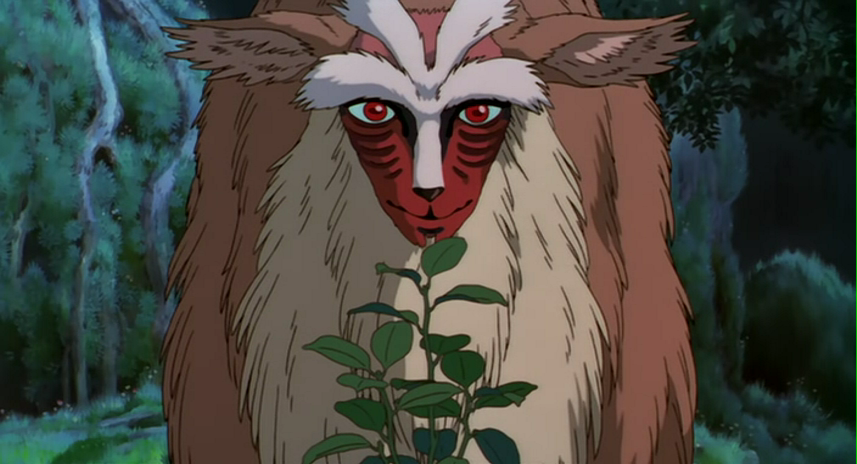
The movie begins with a voice over (or crawl of words in the Japanese version) telling the audience that long ago the land and forests were inhabited by ancient gods who dwelled with nature. We then see the main character of the film, Ashitaka, wandering through the woods. He's told by some village girls that something is wrong in the forest and the elders have called everyone in. Shortly after visiting the lookout, he sees what has caused the forest to grow so quiet. A demon comes through their barriers and knocks down the lookout post. Running in front of it, Ashitaka begs it to quell its rage but the creature continues to charge forward. When it threatens the girls who haven't yet made it to safety, Ashitaka is forced to attack and then kill it in self defense. The creature manages to touch him in the process, scarring him and, later we learn, cursing him. The beast is the first many incredible spectacles the movie has in store for us. It appears from a distance to be a giant insect or spider, but we see later that it's skin and legs are actually made of countless, writhing, worm-like forms, covering a giant boar. Upon its original release, critic Roger Ebert described it as an effect that would be impossible in live-action, and while CGI has come a ways since then, it's still arguable that it could be done this well.

The village elders gather and Ashitaka is told that the scar is actually an infection of sorts, and that it will continue to grow and grow until finally it kills him. Forced out of his village, the only clues he has are that the creature came from the west, and was once a boar that was infected itself by an iron ball that broke it's body and later it's mind. While leaving Ashitaka is stopped briefly by his sister, who knowing the elders' decision wants to say goodbye, and gives him a crystal dagger to remember her by. Alone but for his mount, a red elk named Yakul, Ashitaka heads east seeking a cure.

Heading east, Ashitaka happens upon a village being massacred by samurai and is attacked himself when he tries to run past them. He kills two men with his bow and arrow while breaking free, and learns to his shock that the curse has given him inhuman strength; his shots now have enough force to dismember those he shoots at.

In a village later, he attempts to buy rice with a small nugget of gold (being from a small village he has no coin), and is helped out of a confrontation with the merchant by Jiko, a hunter/tracker who saw him fight the samurai earlier. The two make camp together, and when Ashitaka asks about the boar who attacked him and the iron ball he has, Jigo tells him only that there is a forest to the west where the beasts are all giants like they were at the beginning of time, leading Ashitaka to head that direction in the morning. Jigo, while a humorous character, lets on that he knows a lot more than he says very early in the movie. His craftiness saves Ashitaka not only from trouble with the merchant in the village, but also some men who follow the two immediately afterwards. He also deduces correctly that Ashitaka is one of the Emishi people, at that time a small and unincorporated tribe of which could be placed in harm's way were knowledge of it to get out.

We next see a caravan moving on a narrow path along the side of a winding mountain, transporting goods back to Iron Town. We are first introduced to the Lady Eboshi when the caravan is attacked by giant wolves and she fires an iron ball into the breast called Moro, the very large mother wolf, toppling her down into a river in the ravine far below, but not before she knocks down several of the oxen and men from the caravan.

Far below, Ashitaka hears the firing, then notices men floating through the river, the same who fell earlier. He's able to save two of them, then he notices the wolves and a young girl who is with them. San, is the final major human character to be introduced. When we first see her she is sucking the infected blood out of Moro's wound providing care for her, but wild and uncivilized in the way she moves and acts. When she and the wolves catch wind of Ashitaka watching them, he announces himself peacefully and asks them for help, but is ignored by the girl and wolves who leave abruptly after telling him only to go away.
Ashitaka helps the two men he pulled from the river, one of whom is too wounded to even talk much. The other we learn is named Kouroku, and is an ox driver at Iron Town. He is scared to death of the tiny spirit like creatures called the kodama who inhabit the forest and are small and white and can become transparent. Ashitaka, however, is friendly towards them and even asks them for passage. Following the creatures through the woods, Kouroku repeatedly voices his worries to Ashitaka, but they fall upon deaf ears as Ashitaka trusts the creatures and fears for the condition of the other man if they don't make it to Iron Town quickly. Through Kouroku's actions it is made it clear that the members of Iron Town are afraid of this place and those who dwell within it.

The forest they pass through is ancient and primordial. We get the sense that no humans have walked through in a long time, if at all ever. The glades at the center of it reveal tracks of the girl and the wolves and Ashitaka realizes that this is where they live. He glimpses briefly a figure of a deer with a man's head (a description matching one Kouroku had made earlier as belonging the great "Spirit of the Forest"), but an agitation in his scarred arm forces Ashitaka to submerge his arm in the water to soothe it. Due to this part of the film as well as some scenes later when he recovers from another wound, I've often wondered if the water in this place is supposed to be sacred or have healing properties, and if the water poured by the old woman on Ashitaka's arm right after he is initially cursed by the demon boar in the beginning is meant to have come from this place.

Ashitaka and those with him emerge from the woods safely to reach iron town. Though Eboshi's chief bodyguard Gonza is suspicious of him for passing through the forest, everyone else is grateful to him for saving the two men, including Eboshi herself, who invites him to see her later. Iron Town, we learn, is a safe and peaceful place and though the work there is hard, the conditions are good and the Lady Eboshi is revealed to be a firm but fair and competent leader who genuinely cares about her people. We also discover, however, that it was her forges that made the guns and iron that drove insane the boar which poisoned Ashitaka. When he confronts her on this, she is defended by some of her workers, lepers who were cast away and shunned by all until she showed mercy and took them in. A quiet conversation with her outside on the walls also reveals that the girl he saw earlier is known by the people of Iron Town as the Princess Mononoke (literally translated "monster princess" from Japanese) and that she is believed to have been seduced by the wolves.

The girl in question, San, then makes another appearance suddenly when she directly attacks the village hoping to kill Eboshi. In a very symbolic scene that is probably my favorite in the whole film, Ashitaka defends San from the villagers when her attack goes badly and then even breaks up a direct fight between her and Eboshi, saving one or both of their lives in the process. He also, however, gets shot himself by a nervous gun wielder while walking out carrying an unconscious San in front of the otherwise awestruck inhabitants of iron town. The scene is a very important one. With all the major pieces now more or less in place, we begin to see what the movie has in store for us as the fighting between the two sides -Iron Town and Eboshi on the one hand, San and the creatures of the forest on the other- escalates, with Ashitaka caught in the middle, trying to protect and mediate with both even at a danger to himself. Being cursed and having nothing to lose, he wants only to quell the hatred and animosity the two have for each other and puts himself in harms way to defend both sides. The scene is something of a microcosm for the conflict that is the center of the film, and we'll see shortly just how far all the parties involved are willing to go to get what they want.

After he collapses from his wounds, San takes Ashitaka back to the enchanted glade where we learn the spirit of the forest does indeed dwell. Using a natural marker she leaves him lying on the shore of an island in the still waters of the pond there. We see Spirit of the Forest has a different form at night called "The Nightwalker": gigantic, luminous and transparent like jelly. During the day it takes on its previously seen deer-like form. When it comes to the marker where Ashitaka lies, it simply breathes upon him, and later we learn that by doing so has healed his wounds.

The next day, Ashitaka awakes to discover that he has survived, but that the curse on his arm remains as well. He is so weak he can barely move when San appears to greet him and tells him that she has learned about him some from Yakul (she can speak with animals), who remained by his side despite being released by San the night before. Next comes another incredible scene, as San feeds Ashitaka, who lacks the strength to even eat, by chewing herself the food she has brought him and then putting it into his mouth. I've heard stories that children of Native American tribes would do this for elderly members who no longer had teeth, and while San doesn't seem to think anything of it, it's clear Ashitaka does by the tears that flow from his eyes. It's a scene more tender than many of the love scenes that appear throughout the myriad of other movies out there, we realize what this girl is doing to save his life.This is interrupted by the arrival an army of giant boars who have traveled there to fight Eboshi, furious at her and the fate which befell their friend, Nago (the same boar from earlier who became a demon and cursed Ashitaka). They see Ashitaka there and become enraged and threaten to kill him as well until their leader, Okkoto, appears. Okkoto, wise and old but blind as well, communes with Ashitaka and decides to spare him, but is unswayed by the words of the wolf clan who advise him not to fight Eboshi. We sense that Okkoto suspects a trap, just as the wolves do, but does not fear death in battle and prefers it to the slow extermination facing his kind with man's expansion.Late at night Ashitaka awakes to look out upon the forest. In another stunning scene, we hear a conversation between him and Moro, who regards San as a daughter and has harsh words for Ashitaka when asks her to release the girl, claiming she belongs with other humans. We learn that San was taken in as a child and that the forest and wolves are the only life she has ever known. Though she clearly cares for him, separating her from the life she has now appears impossible.While Ashitaka is recovering, other big things are occurring as well. We see that Lady Eboshi has other problems than the guardians of the forest; a greedy warlord, named Asano, whose land neighbors hers has begun attacking her and Iron Town in an attempt to extort tribute from her. Eboshi, however, armed with gunpowder and iron is resisting fiercely, and Asano appears unable to gain ground against her. Jigo, the tracker from earlier, also reappears, with dozens other hunters, trained killers, in his employ. Calling in a favor from Eboshi, he wants to find and behead the Spirit of the Forest, to claim a huge reward from the emperor, who believes the head grants eternal life.

Things play out very steadily from this point on in the narrative. Ashitaka recovers and heads back towards Iron Town, only to discover it is being besieged by Asano. The villagers tell Ashitaka to get word to Eboshi and the men of the village, who accompanied her to do battle with the boars. After fighting several samurai, and Yakul getting wounded by an arrow, he slips through and comes across the wreckage of the assault against Eboshi and the hunters. Disastrous, and indeed a trap after all, the ground is littered with the carcasses of dead boars. San and Okkoto, who were both part of the battle are nowhere to be found, though one of the wolves is. Ashitaka, though opposed by the hunters there, is aided by the villagers when he tells them of the attack on Iron Town and his intent to inform Eboshi. He frees the wolf and then tries to find San and Okkoto who are being followed by more of Jigo's hunters, and have disguised themselves in boar skins. Okkoto is already beginning to transform into a demon just as Nago did, and San is trying to get him to the Forest Spirit to avoid that fate, but instead is hit by one of the hunter's projectiles and ends up up trapped on Okkoto's head and in danger of becoming a demon herself.

Though Ashitaka is able to warn her, Eboshi continues with her mission to acquire the Forest Spirit's head while he moves on ahead and tries to save San. With help from Moro, who attacks Okkoto, he is able to free San, but just then the Forest Spirit arrives only to breathe upon Okkoto, which this time ends his his life rather than saving it as was the case with Ashitaka. Moro appears to fall dead as well. As the forest spirit begins to transform to into The Nightwalker, Eboshi fires upon it, beheading it for Jigo who grabs the head and takes it in a large iron box with some of his men. The Forest Spirit's body oozes every direction, sucking the life out of everything it touches. For those familiar with Nausicca, this and the offensive with the boars form this movie's daikaisho moments. Moro, we suddenly see, was not actually dead but simply fallen over, and just how intense her hatred for Eboshi was becomes apparent when we see her head make a final leap for the woman only to take her off her arm.
San screams and curses at Ashitaka when he refuses to allow her to kill Eboshi, but in the end the two have no choice but to work together to stop Jigo and return the head to the Forest Spirit. The forest is dying all around them, and the kodama fall lifeless from the trees. A long chase ensues, where Ashitaka is able to warn the villagers of Iron Town to abandon it, Asano's men are devestated by the ooze, and finally the two heroes catch up with Jigo to retrieve the head and return it just as the sunrises.We've seen what happens before when the Forest Spirit changes form in the forest at daybreak, and it is followed by very strong gusts of wind blowing the treetops in all directions. This time the gusts are violent beyond belief and eradicate Iron Town because of the Forest Spirit's proximity to it. In the aftermath of it all, fresh grass, shoots, and flowers bloom from the dead vegetation covering the land. Looking at the villagers again we see that one of the lepers has been cured. Ashitaka's arm still bears faint marks from the scars of his curse though it isn't made clear if it is still active or not. Eboshi shows a quiet expression of regret even as she announces her intent to rebuild Iron Town but do a better job of it than she did the first time, while Ashitaka and San share a final conversation. Unable to live as a human she'll return to the forest with the wolves, while Ashitaka tells her he'll live in Iron Town but continue to visit her. The final shot in the film is of a solitary kodama materializing to look over some newly bloomed flowers hinting at the possibility of rebirth and healing after the destruction which just proceeded.
* * *

Man vs Nature

As mentioned before, the movie functions on two different level, one of which is a representation of the Man vs Nature conflict. The entire work could in many ways be seen as a very long extended metaphor which literally asks: What if nature had an army to do battle with the humans? Nature's army in this case is much more primal and at the same time more primitive than that of Man's. We see that Nature can be elegant and graceful (as is the case with the wolves) though also more brute and angry but clumsy (in this case the boars).

Nature can be kind and simple but also simply harsh and unforgiving. It has a balance of sorts and death is seen as part of a process which gives rise to new life by providing new chances and opportunities for others to live. One aspect of the Forest Spirit which demonstrates this is the way it takes life away even as it gives it back in the same breath. Plants bloom rapidly beneath its feet only to the grow old, wilt and die before the Spirit even lifts its foot: life and death in every step it takes.
The aspects of nature and the forest itself are personified (if you can call it that) by giving speech to the animals so we can hear its thoughts (its pain, its anger, its sadness and fear). The Forest Spirit itself, however, doesn't speak, almost as if to give the most powerful and mythic creature an air of mystery. Neither we nor the humans on screen or even the other gods of the wolf and boar clans can understand it or its ways.

While the main theme of conflict is Man vs Nature, the movie doesn't limit itself to that theme alone either. It does also show us the cruelty and selfishness of man (particularly through the opportunistic lord Asano and the tracker Jiko). In short, the ugliness of human nature is also on display.

What the movie understands and demonstrates so well is that our state of existence hangs upon a fragile symmetry between Man and Nature. We humans reshape the world we inhabit at will, and at times we (like the people of Iron Town in the film) dig out the very foundations that it is all built upon, treating the world like a commodity to be mined and used up, and ultimately leaving ourselves with no out when it's all done.


As a Story of Folklore and Ancient Fantasy

At the same time, Princess Mononoke is also a mythical story which recreates elements of an archaic Japan and mixes in magical elements of its own invention to weave its story.

One element that adds much to the mythological feel is that the giant creatures within it are actually referred to as "gods". Looking back at many of the ancient societies we have abundant information on, we can see that one concept common to many is that their gods were modeled after nature and beasts i.e. The god of the sun, The god of the sky, The god of the forest... The gods of this film also resemble more the ancient ones, like those in the stories of the ancient Greeks, Romans, and Mesopotamians, before our "modern day" concepts of monotheism emerged (that being the one about there being only one, true, all-powerful, infallible, all-caring god who seldom interferes and generally does so indirectly). The gods of this film are at times angry, wanton and cruel, and at times cannot be negotiated with.

The human characters represent of the film too, represent the different aspects of humans today towards Nature, and while this does in some ways overlap the Man vs Nature argument, I thought it best to include it in the story telling analysis.

Ashitaka and his tribe (the Emishi) are based on a real group of people who lived in the northern part of Honshu. Not much is known about the Emishi, but it is believed they had ties and similarities to the Ainu (the original inhabitants of Japan), and such influences are very apparent in this film's recreating of the Emishi.

As portrayed in the movie, there are a lot of Ainu-styles in the group, for example, the cut and patterns of their kimonos, the stone arrowheads, and clay fired pottery they use. The real Ainu were eventually forced further and further north until Hokkaido became something of a last frontier for the "Japanese pioneers" if you will. Japanese history in this way mirrors colonial america but in this version, the Ainu were nearly completely absorbed or killed off unlike the Native Americans, some of whom managed to survive with both their genes and culture intact.

The real Emishi were believed to have been something of a mix between the modern day (asian) Japanese and the Ainu. They survived the onslaught of the encroaching Samurai fiefdoms by fighting them back and managed to stymie them for a while because their style of fighting was different. The warriors of that time tended to be heavily armored foot soldiers, and the Emishi were good at firing arrows on horseback allowing them to pull off some very daring surprise attacks, ravage their enemies and then retreat faster than they could be pursued. Eventually their enemies adapted and many Emishi either joined their former foes or were wiped out in the years following. Ashitaka fights in a very similar way (mostly bow and arrow, though he rides Yakul rather than a horse). He also uses a blade very different than the katana which were specialized for war. His looks a bit like a machete and was probably used as a tool as well as fighting.
Above: Pictures from the film of Ashitaka's tribe
Below: Actual photos of Ainu

It is very telling and symbolic of Miyazaki to chose this group of people for Ashitaka's origin. Perhaps it reflects a belief that the old and new ways must coexist: respect and harmony with nature while at the same time a willingness to harness it and acceptance that doing so helps save more lives and improves them. In our story, Ashitaka cares about the forest and wants to save it but also loves human beings and has no desire to see them suffer either.

The Lady Eboshi on the other hand, is very driven and "doesn't even fear the gods" to use the words of other characters in the story. She'd be the villain in another, simpler movie, but is in this one presented as a real but complex and flawed character. She cares for her people and is kind to them as shown by the way she takes in brothel girls and gives them a better life. But she is is also completely merciless to those she feels will try to hurt them as we can see by her dealings with the ambitious Asano clan that lives nearby.

Eboshi is willing to destroy things that are irreplaceable in order to advance her goals, for example her attempts to kill the Forest Spirit. She is also very mistrustful of men, and she looks out first for the women under her care. It would seem that perhaps in the past she has had some sort of experience or other to make her lose faith in the opposite sex, and at the time the story takes place, men would've had much more power and sway in the hierarchy of society. Eboshi seems very aware that the world is unfair (especially towards women) and is willing to go to greater extremes to be the one taking advantage of others rather than the other way around.

The Princess Mononoke of the title, San, however, I suppose one could say is the tree hugging hippie of the group if ever there was one. Her desire to kill Eboshi and destroy the ironworks has shades of the kind of eco-terrorism that is sometimes practiced today (sabotaging plants and drilling stations, putting one's own life and that of others in danger to do so).

She is a complex figure because she is human but sympathizes with and behaves like an animal. As mentioned before, her movements, actions, the way she fights are all have a wild an uncivilized manner to them. Ashitaka tries to appeal to her human side to quell her fury at a few points in the tale; he tells her she's beautiful to disarm her when when she has a knife to his throat, and later, after Eboshi is dismembered, he defends the woman from her and when in the heat of passion she says she hates all humans, he replies "But I'm human, and so are you..."

In the end, San cannot be "turned" or made to change sides. There is no love story between her and Ashitaka (not one that is completed onscreen in the time we see them at least) because doing so would have been a false sort of cop out when examining the true nature of the characters created and their motivations.

The supporting cast of the film also fit familiar roles: Gonza, as the bodyguard who defends Eboshi unconditionally and poses an obstacle to anyone who disagrees with her; Kouroku and his wife Toki as the bumbling and reliable sidekicks, respectively; and finally, Jigo, who in addition to some providing comic relief, also proves to be a very cunning and dangerous adversary when the situation arises.

The ending to the film is left somewhat open to question; to an extent we're left wondering: "What exactly happened at the end? Did the forest spirit survive or die? And what does the future hold with so many of the gods dead and iron town destroyed?"

It is likely that the warlord Asano would try and retaliate on Eboshi for all her slights against him and rebelliousness, but then it also appears he has suffered severe military losses after the flood of Forest Spirit's body washes over his army in waves of widespread death. It is also likely his men would return in shame telling wild stories of what happened that would scare others from approaching Eboshi for some time.

Iron Town would likely be rebuilt though it would take much time to regain what was lost, and it is unlikely the villagers and Eboshi would be so bold or brash this time round.

The forest would recover, as is shown by the final shots of the film, but with the protection of the spirits dwindling down it would be far more vulnerable too. An age of Man's dominance is a trend that began long ago and continues through the events of this film, even to the people of today. In the end, there are no spirits and gods to defend Nature from our hands, it is only our own judgement and restraint that keeps the world we live in healthy and sustainable into the unknown of the future.


Final Thoughts

If there's one common thread throughout all of Miyazaki's work (with the exception of Lupin the 3rd, Cagliostro, which also wasn't a character originally designed by him) it's that he's used the same composer, Joe Hisaishi, who in many ways resembles a Japanese John Williams or James Horner and is known for very sweeping, classical, symphonic scores. In Mononoke, his score is superb, even when compared to his others, and the main theme is immediately recognizable in Japan.

The movie itself has a lot of stylistic elements in common with other Miyazaki works, but then, so do many of his others. Ashitaka's traveling cloak and those of the hunters are very similar to some of the forest cloaks in Nausicaa. The fox cats (not sure if they're really called this) appear in both Nausicaa and Laputa which also had similar technology, the Forest Spirit looks very similar to the shadow form of the emperor's younger brother in Nausicaa. Nausicaa itself, along with The Journey of Shuna share the most similarities to this work, Nausicaa shares the theme of environmental destruction (though believe it or not takes the metaphor to an even greater extreme), and Yakul the red elk appears in Shuna as well. At times it feels like all of Miyazaki's stories take place in the same universe just at very different times.

The first time I saw this film, I drove over three hours out of my hometown when it appeared it would not be playing there. I saw it in a place unfamiliar to me, an artsy theater in LA near Santa Monica. I was surprised at just how many families had come; there were many children in attendance. While the movie does have some blood and violence, and there were occasional gasps of surprise from the audience, there was never any screaming or crying or signs of horror or discomfort to give any indication of it being inappropriate for kids. Instead there was a lot of excitement and surprise, an atmosphere of joy and wonder at what was unfolding onscreen. I remember thinking to myself how great it was that parents would take their children to see something like this which aside from being great for the spread of anime (at the time it was very rare for anime to play in theaters in the US), it was also that what was being watched was not just mindless entertainment but truly thought-provoking, inspirational material that could change and influence a person for the better, especially if viewed from a young age. As for my own thoughts on the film, I remember loving the experience of it so much that I actually wanted to see it again before finishing it the first time. It is without a doubt a film that gets better on repeat viewings, allowing one to see things they didn't notice the first time and appreciate the craftsmanship. It is a film that can change you by watching it, and live with you long after the screen dims.

Thursday, July 22, 2010

Film Noir (2007)

It's style over substance in this luridly entertaining animated movie. It boasts black and white visuals with just a little color thrown in for style (think Sin City), tons of classic noir imagery (piles of just smoked cigarettes, 50's style diners, strip clubs), and an amnesiac protag who narrates his own story in a worn down voice that sort of says "Seen it all, heard it all and still don't know what to make of it..." It takes place in LA (largely around Hollywood) and also has a lot of nudity and sex in it, especially for an animated movie. This one is for those who like dark gritty settings and messy complicated plots.


Please note: Entries about media reviewed in this blog are written from the perspective that the reader has already seen the work in question and desires further commentary or explanation. Plot twists and endings will sometimes be examined. Though in the case of this film, I'll try and keep spoilers to a minimum, being that it isn't a major work.

The man wakes up lying in front of the Hollywood sign to find blood on his hands, and a dead man nearby with bullet between his eyes. He has no idea who he is or how he got there. A quick examination reveals that the dead man is a cop, and with no one else around, deduction tells us that our main character is the killer. He flees the scene quickly hearing reports of shots fired on the police radio, driving away in the dead man's car. He cannot find any ID but it's clear that someone wants him dead, and he has no idea who or why. Not knowing who he is, what to do, or even where he is going, he muses to himself: "One thing was for certain, I was the bad guy in this story."There comes a point a while later in the tale, where our main character reasons that if he'd had a choice between being lucky or good, he'd chose lucky every time. I can't help but think this guy really does have that kind of luck too given what happens over the course of the film, and two of the biggest examples occur right towards the beginning. The first of which is when he decides to visit the house of the man he just killed, figuring that at least that guy wouldn't be home, only to find half the police force and the guy's family waiting there to surprise him with a party. Only some quick thinking gets him out of that jam. The second occurs at the office of Sam Rueben, where he's led by one of the few clues he has amongst his possessions in the car. Upon leaving the office after getting the run around by the secretary, he is called by that very same girl who mistakes his voice for Rueben's (it appears he has Rueben's phone, and neither he nor she knew it). "That guy you were looking for was just here" she says. "Who?" "David Hudson, you idiot!" And so now our protagonist has a name, or at least an identity people believe him to be.

We follow the man around as he gets lucky again and again (women he cannot remember want to sleep with him, old accomplices give him help and valuable info/items even though he doesn't know what to do with them right away) and also has several very unlucky encounters (he's chased around and gets beaten up a few times, and even has armed men in a helicopter trying to kill him). "The more I learned about David Hudson, the more I realized what a despicable guy he was." we hear him think at one point. We see him make attempts to change the way the people around him see him and act towards him, as when he refuses to whip and beat a woman who knew him and is an addict to both heroin and S&M. He confides in some, needing at the very least someone to trust him, and conceals himself to others, bluffing about how much he knows to get away again and again. He gets caught by the cops, only to have fate step in again with another strange turn when the men who come to kill him end up inadvertently providing him a chance to escape.It all leads to a safe-deposit box that he at first is unable to get into, and the revelation that the one out to kill him is publicly a well regarded philanthropist but secretly is a corrupt and perverse man who wants what is in that box too, as well our protagonist dead. We also learn that our central character is not who he thinks he is in one very startling scene.

The conclusion to the story comes after the standard fare for this kind of flick: shootouts, deals with the police, recovery of what's in the box. We're told the identity of our central character, though thinking carefully about the reasoning behind it, it has its holes: "Did this guy really not know there'd be risks doing such a thing?" I asked myself immediately after learning who the man really is and why he has the face he does.
The style is really laid on thick in this movie, and done well for the most part, the atmosphere really drips of classic themes mixed with neo-noir elements. The action, however, isn't always handled in a believable manner (the henchman in the helicopter seems dangerous and cool at first, but absolutely defies logic, and seems more of pest by the end of the movie). I was reminded at times of video games I'd played with similar style that were just a little off in execution when compared to their movie counterparts (Max Payne and the GTA series, especially 4). All in all though it does make for a very fun hour and a half of viewing if noir is what you're into.

* * *

Amnesia, it's said, is very uncommon in real life and generally you retain nearly all of your memory, losing only what is most stressful of painful. It generally happens to memories more in the present tense when the person in question is under extraordinary circumstances. Forgetting one's past is extremely rare and I would guess occurs in only those with the most unbearable histories. That we see it so often in films and TV and books and other stories I think has less to do with what I just said, and is instead more a testament to usefulness as a plot device. The idea of losing one's past is intriguing and proves an often irresistible concept to storytellers. While not an overly complex piece of work, Film Noir does allow its lead character a few instances to ponder his existence over the course of the tale. "The problem with having amnesia is that you hold yourself to impossibly high standards. You're like a new-born, a child, a virgin, a clean slate inside, but on the outside you're not, you have a past, have done things, hurt people." Sometimes I wonder if noir itself, as a genre isn't uniquely suited for the element of amnesia. Its stories are often mysteries and when the central character is already in the dark about whodunnit then why give them the added challenge of losing all their memories so that they have to solve that as well? There's also the grimly illuminating idea that were a person to lose their memory they would quickly be seized upon by those willing to use them and take advantage of them -anyone who's seen Memento (another dark noir-like film with an amnesiac hero) will recognize this one. Finally there's just a sort of dreamlike quality to most noir, that comes of having a strange world that doesn't quite feel right, and characters inhabiting it who don't act normal, don't follow the rules. In the world of noir, it feels like no one can be completely believed, nothing is what it seems, and everything is open to suspicion.