Tuesday, June 8, 2010

The Hills That Watched Me Grow

As a teacher of Japanese school kids I sometimes find myself telling them about my life back home. A recent story I told some of my classes about school in America and its differences with school in Japan turned to something more when found myself suddenly bombarded with a ton questions about the details of my childhood in southern California. The whole thing left me grasping for memories that had long since flitted away in different directions like birds out of a cage suddenly free. Of particular interest to them was how summer vacations played out in the US since it lasts a full month longer for the kids in America (kids in Tokyo are only off the month of August and for a few weeks in the end of July). It's June now and with the American summer about to begin, I find myself waxing nostalgic about the life I had that once was.

Summer vacations in my hometown of Santee were long and slow and lazy. My parents sent me and my brother and sister to summer school a few times to keep us busy and because there weren't enough kids to make a full school several districts were combined and we occasionally were bused to other elementary schools to mix with other kids from Hill Creek, Rio Seco, Pepper Drive. Summer school always ended in August anyways and so even with it, we kids found ourselves with a ton of time on our hands. Daytime television was boring as hell and so we ended up geeking out on video games for SNES and Genesis far more than was healthy. RPGs took up whole blocks of my break. Mostly the ones by Squaresoft. Also hanging out at our neighbors' place playing Street Fighter II and listening to his old hip hop CDs. Snoop Dogg and Warren G were really popular back then and the West Coast was becoming known for its sound (the creation of G-Funk). It kills me sometimes to think of how many white, asian and mexican kids living in the suburbs of southern Cali would sit around watching Boyz N the Hood and Menace II Society. We shot hoops during the day when it wasn't too hot and occasionally played games of street football in the afternoon or early evening when things had cooled down. We'd drink beers bought by someone's older brother, or alcohol taken from the liquor cabinets of friends' dads and other times spent the day sitting around playing cards with MTV or Jammin Z90 on in the background. We were mostly too poor to buy CDs, that or just about always seemed to want to buy video games with the money we'd saved up and so MTV or the radio was just about always on to give us something to listen to.

Our bikes gave us mobility and we sometimes didn't know where we might end up going when we set out over the course of a summer day's lackadaisy. We'd head out to town center, to Santee Lakes, and sometimes all the way down Magnolia Ave to Wunderland, the nickel arcade, where we'd spend hours (and tons of nickles) on games like Samurai Showdown and Alien vs Predator. In and Out Burger was there too, still just about my favorite when it comes to fast food, and one of the places I miss fiercely now that I call Japan my home instead of Cali. That and good, cheap Mexican food on every corner.

Candybars may have cost a nickel when my parents were young as they so often liked to remind us, but back when we were kids three for a buck was about the best we could do and you had to bike to the drugstores like Long's on a hot summer's day for it though you usually had to eat it there or it'd melt some before you got home. Thrifty's on Cuyamaca and Mission Gorge had really cheap ice cream which I'd learned long ago when I was little and realized that my mom I would buy it for me almost everytime I went running errands with her that took her to that store.

It was also at drugstores that you usually found comics. We'd read as many as we could before we either got bored or were given sharp looks by the storeclerks telling us it was time to leave. I think it was in an actual comic store, however, that my brother and I first discovered manga and a love for the new and different form took hold in me. From it I suppose you could say sprung my interest in Japan and ultimately my desire to see it firsthand. Funny how one thing can lead to another...

My little brother built a treehouse out in the unclaimed area behind Rio Seco. It was mostly made of tough, black netting draped between the large boughs and then pinned and tied on super tight to hold our weight. Oh, and old boards nailed up the trunk to give us a ladder to climb up. It was like a set of large hammocks to relax in. We got high in those branches a few times while hanging out and wasting time.

Not far from our house is a series of rolling hills that used to be a quarry for mining or something like that long ago. Santee has changed a lot from when I was young, there used to even be some stables and horses there on some of the properties when I was a child. Even at that time those little "ranches" (if you could call em that) were really starting to dwindle. We used to go hiking in those hills when there was nothing else to do. It was my dad who first introduced my brother and I to it. We would go on weekends up those big and dusty mounds covered with brush and dried out shrubbery and large white boulders some of which had been sprayed painted up by others. We hiked up the hills and climbed up the rocks, scurrying and jumping gaps, and learning how to gain footholds and grab handholds with our fingers to pull ourselves up. The rocks came in all shapes and sizes and my little brother and I gave silly names to all of them (many of them after which of our favorite cartoon characters they reminded us most of, mostly Disney characters or GoBots). I remember in the beginning the big one we would go to, we called "Mickey Mouse Rock" because it was two large boulders on an even larger boulder and the way they were set kind of reminded us the famous mouse ears. If you sat between those ears you'd get a nice breeze that blew over the valley up the hill and whistled between the two rocks. It also gave you a great view of Santee including where we lived at the time and Cajon Park, the elementary school we went to. Other impotant ones were Blue Rock which must've had a half a hundred coats of paint on it (all by various passersby over the years) before it ended up being the color which gave it its namesake. And finally there was "Boot Rock" which we'd named for it's shape. It was the one nearest the old quarry with its hundreds of abandoned shards of stone laying scattered and stacked unevenly about like the gigantic wooden toy blocks of some long forgotten colossus. You could still see the grooves in the old stones where those who'd worked the quarries before had drilled the holes to put in the blast caps and break the stones aparts. I used to go up there with my friends and we'd play hide and seek in those piles of old blocks. If there was one thing that place provided, it was a lot of good places to hide though we found after a while that it was easier to catch people by listening rather than looking. The sounds of nature were all around but the rustle of loose gravel and echoing of footsteps was easy to hear.

I remember hiking up there with my little brother and Dad one spring after some heavier rains and stumbling onto something which has lived on long in the fuzzy memories of my childhood. In a deeper puddle of water left by the rain runoff we found some tadpoles and even some frog eggs with the little black creatures wiggling round inside them. My dad, perhaps sensing an opportunity to teach my brother and I something about nature, suggested we return with jars to catch some of them so we could watch them grow before returning them to the hills. We did so, and returned each year when the seasons changed to collect the little froglings in old pickle jars and applejuice bottles. "Polywogs" we used to call them and I still remember many a morning spent crouching down on a little shard of rock catching them in the "Big Pond" and "Little Pond" as we called the two places we most often could find them. If it was my dad's plan, it worked, and we did indeed learn a few things about nature by catching and watching them. We learned what they ate, what they looked like as the grew, and that when animals in the wild that have a lot of offspring all at once, only the most robust tend to live to maturity, even with a safe environment to grow in.

I first moved out during my years in university and found myself spending more and more time driving to the beach and surfing since I now had access to a car and lived closer to the shores than before. I'd drive home to see my mom and dad, occasionally do my laundry, and use the computer and burn CDs out of mp3s I'd downloaded, though I sometimes wonder now if this wasn't more just an excuse to go back and visit. I'd watch the Simpsons with my brother and sister if they were around or stay for dinner if it was late enough. My friend Phil said it best when he told me that at first the house you grew up in will seem like it's always been, but that gradually it simply ceases to be your home.

The first time I left California was in 2003. I went to Florida. I came back after several months when things didn't turn out quite as expected, and then lived in San Diego for a little over a year before deciding to come to Japan since Phil had moved here a few months earlier. I've been here for over four years now.

Living away from home during college I noticed how much faster things changed each time I came back home: a new building here, a shop closed down there. Nowadays when I return I see the changes happening by leaps and bounds with each turn since it now occurs only seldom over a matter of years rather than weeks or months. The one thing that never changes is the hills around my hometown. I'm sometimes reminded of the Chili Peppers' song "Under the Bridge" and he way Anthony Keidis refers to his city as an entity that can see and empathize with him. If there's ever been a place I've identified with it's them, the hills that surround my hometown. As I got older I found myself visiting them less and less over the years. We'd still go hiking up there every now and then with beers or bottles of alcohol and we'd get drunk or get high while chatting and looking out over the little city that raised us. At night we could see the lights of Santee shining like a puddle of stars that had spilled into the valley, interupted only in the areas where the hills rise out of the ground by the blackness that is nature at night, devoid of manmade light. The last time I came back to Santee was last summer, 2009 to see my friend Josh get married. That was the last time I visited the hills that watched me grow. Each time I go up it surprises me to see the way the urban sprawl of the city keeps slowly creeping up the sides of the valley, coming ever closer to the quarries and the rocks I climbed as a child. I wonder sometimes if it'll ever all get cleared away to make room for more houses.

It's not that I long for the past so much as treasure what memories I have been able to have. I know that things change and we can't go back, it's what makes the past so stirring and for that same reason the times we live in now so exciting. There's only one now. And things will never be same.

The hills surrounding Santee

Topmost on the hill: "Mickey Mouse Rock"; you can see how the two smaller boulders on top make sort of like "ears"

Mickey Mouse Rock up close

The view from between the ears, you can see the school from here


Blue Rock

It's in the shell created by these shards of rock that the water collects like a bowl after the rains. We called it the "small pond" next picture as well.


A bunch of rocks and dirt had fallen into where the small pond was when last I went up there to see it

The old quarry in front of where "Boot Rock" sits.

Boot Rock closer up

The quarry we'd hide in

Boot Rock over-looking the city

Sunday, June 6, 2010

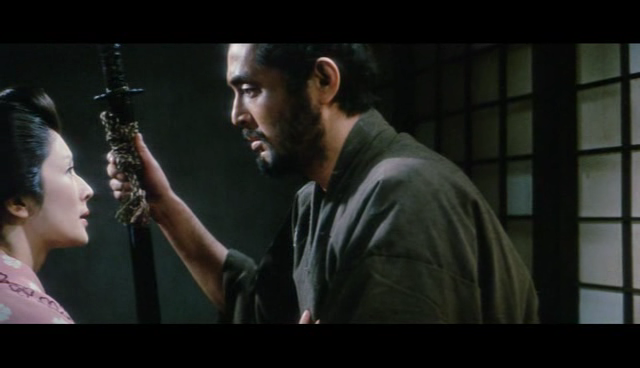
The Warrior Spirit: Hideo Gosha's Goyokin


Released in 1969, and today known mostly by only those with a special interest in samurai flicks, Goyokin is one of the standouts of the genre. It has several well-coreographed fight scenes, and stunning imagery from the technicolor era, but the acting and plot (which bears several shades of resemblance to "Ninja Scroll" for those who are anime fans) haven't been neglected either. It's just dramatic enough to make us care but still a manly enough story to rouse us when the main character, Magobei, decides to confront the demons of his past, even if it means opposing the clan leader he once called a friend and all the man's soldiers as well.

Please note: Entries about media reviewed in this blog are written from the framepoint that the reader has already seen the work in question and desires further commentary or explanation. Plot twists and endings will sometimes be examined.

The movie opens with an explanation of a how certain capital bound ships loaded with gold would regularly make their across a perilous stretch of ocean to their destination. Next we watch as a young woman named Oriha (Ruriko Asaoka) returns to the small fishing village she came from only to find it deserted and dilapidated. The scene proceeds for quite some time without any music or even dialogue and is a bit eerie in feel. Everyone in the village has mysteriously disappeared, "kamikakushita" as the Japanese put it, which Miyazaki translated as "Spirited Away" (Sen to Chihiro no kamikakushi, literally Sen and Chihiro's spiriting away), but is translated in this movie instead as "taken by the gods". Darker words for a darker story.

We then cut to a scene of feudal era Edo three years later. Our main character, Magobei (Tatsuya Nakadai), is introduced as the equivilant of a carnival samurai. Scraping by a living by showing off his swordsmanship to passersby at a festival. We will learn shortly that he's entered a self imposed exile, that something bad happened in his past which has brought him to this point. He is broken and appears to have had the fight taken out of him. He even appears ready to sell his own sword. "What honor is there to being a samurai?" he quanders when asked if it means he intends to quit his profession. Magobei does, in the end however, change his mind and keeps his sword, and just in time it would seem too; he soon finds himself surrounded by armed men come to kill him. We see quickly how skilled a swordsman Magobei is watching him handle the would be assassins with little trouble. He offs four or five men in seconds and then exhales like a man who's gone without breathing for three years. He is given much pause, however, when he learns that these men are from his former clan and the reason they've come to kill him.

A flashback shows us what pushed Magobei to quit his clan in the first place; the members of the tiny fishing village who were "taken by the gods" three years earlier were really killed upon the order of Magobei's clan leader, Rokugo (Tetsuru Tanba) who did so in order to steal the gold of one of the official ships, which passed through waters nearby, and conceal the evidence. Magobei left the clan voluntarily to avoid fighting with Rokugo, who not only is his leader but also the brother of his wife. It is clear he disapproves of Rokugo's decision. Though he makes Rokugo promise never to do so again, Magobei learns from his former clan mates come to kill him, that the man intends to do just that. And so our lone samurai vows to return home to confront the man he once respected despite the large number of warriors at his command and his relationship as a brother-in-law.

At this point we are also introduced to the other characters in the story. It is revealed that Rokugo's second in command, Kunai (Isao Natsuyagi), was the one who ordered Magobei killed, and that he did so without Rokugo's knowledge or consent. Kunai is a slippery, sinister man who unlike Rokugo doesn't have reasons to want Magobei spared, and feels that killing him is the safer course of action. We meet Shino (Yoko Tsukasa) as well, the sister to Rakugo and wife to Magobei, who gives the two of them pause to fight with one another. She is sent, early in the film, to go see Magobei in (we shall learn later) an attempt to dissuade him by different means. The young woman from the beginning of the film reappearsb as well. Though being something of a tragic character, having lost all her family and friends, she's actually very feisty in behavior; when we see her again she is working at a gambling house and attempts to cheat a group of yakuza at dice with an accomplice, Rokuzo (Ben Hiura) a young man she appears to have met over the years. Their attempt fails and they end up running away only to be surrounded. Perhaps in an attempt to try and scare the men away she calls herself, "Oriha, Taken by the Gods" (although forgotten by the gods might actually have been more appropriate given she was left behind). Magobei, who by chance happens to be passing by (in one of those coincidences that only seems to happen in the movies), overhears her part of her story and saves them from the angry gamblers. Tearfully, she later tells Magobei that she was away from the village working to save money for a wedding kimono, which Magobei knows was later used in a decoy wedding procession to get the villagers away to a deserted place to be slaughtered. It turns out, however, that Oriha is attempting to get more information out of Magobei for Samon (Kinnosuke Nakamura) the last of the film's major characters, a shadowy government spy who's good with a sword, but working alone.

Things proceed from there as Magobei makes his way to a confrontation with his old clan. There's fight in the rain in a run-down, abandoned mountain town where Magobei gets forced into a house his opponents set to fire, though in the end he's able to escape thanks to Samon. Then comes perhaps the most pivotal scene in the film as Magobei meets with his wife, who begs him to leave it behind and come away with her. She clearly is worried that he'll die, and tells him she has some money saved up and that they can make the beginnings of a new life with it. Magobei sees right through the situation, however: "Rokugo gave you that money, didn't he? This is his attempt to bribe me to close my eyes once more." The scene is important because it shows our main character's resolve. It reveals things about his psyche that he doesn't share with any of the other characters. He feels he compromised his honor once before by closing his eyes, and refuses to do so again.


As I mentioned once before, the plot to this film resembles that of the anime "Ninja Scroll", with its plot to steal gold from a ship passing by. Magobei is able to figure out that Rokugo plans to sink the government ship by placing warning fires in incorrect positions to run the ship aground, afterwards using the "Taken by the gods" routine once more. Together with his companions, Samon, Oriha, and Rokuzo, Magobei is able to thwart Rokugo's plan, saving the villagers, allowing the ship to pass safely by re-lighting the correct fires, and demolishing Rokugo's soldiers in process.

The final showdown is a stunningly shot duel in the snow between Magobei and Rokugo. Watching it we feel the emotion between these two men. The mutual respect that once was, but has since turned into contempt. We realize that these two men have absolutely destroyed one another. Rokugo by shattering Magobei's honor, Magobei by ruining Rokugo's plans.


* * *


Goyokin is not a great film, but it is a memorable one, and it's easy to see why it's considered a classic within its genre. Many of its elements may appear to be simply adequate, but the creators made a lot of intelligent choices which add up to something more than just another well done samurai flick.

The plot is good, functional as a vehicle for some great fight scenes, but not without an emotional center either. We never doubt that the main characters are motivated by realistic desires, whether they be ambition, revenge, or redemption. The characters are good as well: Magobei, Rokugo, and Shino provide the serious elements, Samon is sly and cunning, but humorous also, and together with Oriha and Rokuzo (the two of whom remind me a little of Hyakurin and her bumbling sidekick from the "Blade of the Immortal" manga) help round out the comedy relief. Nor are the characters one sided either. Rokugo is more than a one dimensional villain, being that he despises the greed of the shogunate he's subjected to, and actually wants to improve conditions for his clan, even though his means, it's hard not to argue, seem selfish and cruel. He honestly believes he's acting with the best interests of the clan in mind. His attempts not to hurt Magobei too, show a sort of respect for the man even when they find themselves opponents.

The acting is uniformly good as well with the main character Tatsuya Nakadai as Magobei being the real standout. I remember reading or hearing somewhere once about the Indian actors and that what made them so amazing was the way they "acted with their eyes". While I'm not much a judge on Indian cinema, I do have to say I thought that Nakadai had something of a similar quality in this film. His eyes are always intent, focused, and reflect the unrelenting nature of the character. He is completely and totally driven. "What is he looking at?" I find myself thinking. There's pain and a sadness there too, as well as a regret which we know is for things unchangeable. And finally perhaps a trauma that comes from seeing things that would drive any ordinary man off the deep end.

Finally there are a lot of little details that really help propel the film beyond the usual fare common to films of this type. Beautiful cinematography: bright red blood on snow, a storm of crows in the sky getting ready to feast after a massacre, the men in masks hammering away at drums in the final scene. I liked the look that passes between Orhia and Magobei before he continues onward at the end, a look of approval or forgiveness perhaps, from this girl who had everything taken from her once, and only now regains some measure of justice. The final shot was great too. Many westerns end with the hero riding into the sunset on the plains. Goyokin instead ends with Magobei walking into the sunrise upon the snowfields in a scene of ethreal beauty, followed behind by Shino.

Friday, June 4, 2010

Perfect Blue


It's a thriller of a surprisingly high caliber, and one that might've found a larger audience or even played in a mainstream theater had it been a live action flick (it was intended originally as such until the Kobe Earthquake forced the studio's budget down), but as it stands Perfect Blue is a good example instead of a film with dark and mature features that westerners would not likely expect in an animated feature. It has managed to become somewhat known amoung anime afficianados (in the US at least), and while it might hold a bit more meaning to the Japanese audience it was intended for, its well-crafted plot and well-hidden surprises certainly make it a work that can be appreciated by anyone who enjoys this genre.

Please note: Entries about media reviewed in this blog are written from the framepoint that the reader has already seen the work in question and desires further commentary or explanation. Plot twists and endings will sometimes be examined.

I thought it might be instructive to quickly go into the setting of the movie before beginning. The movie starts and takes place largely in Tokyo's Akihabara district, an area well known for its convergence of cheap electronics, and "otaku" culture. I can't help but think that this movie benefit from a different level of understanding amoungst those who have experienced Japan (specifically Akihabara). The first time I watched this movie was just after I finished high school in america over 10 years ago. I have been living in Japan for the last 4 years, and only had the chance to rewatch Perfect Blue recently. Lot of things I caught this time around that I didn't notice the first. The word otaku that I mentioned earlier is one that roughly translates out to "enthusiast" or "hobbyist" and could be used to describe anything someone can be interested in though it's generally used to refer to those who like anime. It's practiacally entered the american lexicon with such a meaning, though in practice when it's used by the Japanese it has something of a negative connotation. The typical person on the street in Akihabara is a Japanese male and one who doesn't look like they at all care to dress trendy or cool or fashionable. Though a lot go there looking for stores with deals on technology there are also a lot of strange and bizarre hobby shops as well. Pornography lines the shelves in plain view of customers, hentai (perverted) anime, figurines, blow up dolls shaped like anime characters, etc... It's hard not to get something of a sickening feeling at times looking at what's being sold out there. I've heard there are vending machines selling used panties, and a friend once pointed out some DVD's on a shelf with child models in bathing suits and other "cute" outfits. Child pornography might be illegal in Japan, but it's not difficult to guess why the guys wandering around out there are buying the stuff.

It strikes me as well that guys in Japan, not just young adolescents, but even full grown men are into the girl groups that sing poppy-sounding songs about first love and things like that. The typical american guy is quite a different story; the guy might think Brittney Spears is cute, but is very unlikely to go and see one of her concerts, even if it were free, let alone shell out money to do so. In Japan, however, men basically are the audience for this type of music.

The main character in the film is Mima, and it is from her viewpoint that we see the events which transpire, though by the end we will most likely be questioning the accuracy of said perspective. As the movie opens we are given a glimpse of Akihabara's streets and then overhear some of the local rumors floating around about Mima as well. She's one third of a pop trio called Cham, and we next see her getting dolled up before a performance and then dancing onstage with the other group members. Mima is alot lie a doll herself and the opening shot show us. The movie cuts back and forth between the excitement of the song and dance and the monotany of her regular life, commuting by train, buying groceries at the supermarket. Her managers, Tadokoro and Rumi, argue over the decisions they'll make on the direction of her career, referring to her in the third person (though this is partly a language difference) even though she is right in front of them, in the same room. Because she has taken acting lessons, they both feel she has the ability to get farther by concentrating soley on this, beginning with dropping the singing and music for a more serious image. In her first acting part she has only one line with another character: "Who are you?" Rehearsing it to herself before the filming, she repeats it obsessively to herself: "Who are you? Who are you? Who are you?" shutting out all those around her to concentrate on what is in the end a very mundane line, though it is rather instructive to note this line, considering she'll very soon go through something of an identity crisis herself.

As Mima begins to make her announcement to leave the group, several drunk and beligerent guys in the audience begin making a commotion, hooting loudly, throwing beer cans at the stage, and provoking a security guard. Things even get bloody when one of them punches the guard who comes to deal with them. A long shot of the stage with the girls in the foreground shows us that the crowd is entirely made of men who are beginning to get loud and irrate, and we realize with some fright that it is the girls they are fighting over. One can only imagine what the girls are feeling in a situation like this. Mima breaks the argument up by shouting for every one to stop, followed by the announcement of her decision to leave Cham, much to the disappointment of her audience.


Above: the member of Cham, Mima on the far right,
Below: Cham looking out at their audience, made entirely of males

Below: members of the crowd start getting ugly, they are fighting over the girls


Mima has her share of fans. One particular plot element that shows us the age of this movie is a website called "Mima's Room"; at first she doesn't know what a fansite is, and has to be walked through and shown by Rumi how to access it (in this modern age, even those with low computer skills wouldn't have much trouble with this, but at the time of this film's release not as many people used the internet as regularly as today, nor were people as familar with it). "Mima's Room" purports to have been created by the "real" Mima, and even has a diary chronicling the daily details of her life, and even though she didn't write it, things only Mima herself should know are found on the site.

There are people who are very upset at Mima for leaving her group. She receives threats and even a letter bomb calling her an imposter, reads things saying the "real" Mima is a singer, and the "Mima's Room" website at times continues as if she still were. The anger towards her only becomes more intense when she agrees to do a rape scene in exchange for a larger role in the series she is working on. That scene itself stresses the mechanical process of filming with the actors being filmed quieting down and then immediately getting back into character with each cut, and though it doesn't seem to us that the filming of it should cause any mental instability, the movie does let us know that there nonetheless is and psychologically things begin to split at this point in the story (an irony mirrored by the fact that the role Mima herself is trying so hard to get into character for goes through an identity split herself for that respective series' plot).

The threats and animousity towards her, combined with the pressures of her new job begin to wear away at Mima's rationality. In the midst of all of this a doppleganger appears wearing one of Mima's singing outfit, saying that she is the real Mima and taunting her when she tries to get closer and uncover her identity. We also get a glimpse of an obsessed fan called MeMania who appears to be behind some of the threats and violence aimed towards Mima. Things start to become very bloody and some those working closely with Mima start getting murdered in really brutal ways including one of Mima's managers, Tadokoro; the writerfor the series she's working on; and a photographer who took pornographic photos of her for a magazine spread. In the latter of these murders, Mima herself appears to be the killer and the way the film is edited, each cut she makes with the knife is a cut on film as well, flashing the images of her photo shoot as memories of anger in her mind. The lines of reality are breaking down in Mima's mind, she seems to be having trouble understanding whether or not she is herself or her series' character, and we in the audience have trouble figuring out if it is indeed her who commited the murders (whether consciously or subconsciously) or not.

Above: the doppleganger makes its appearance
Below: the room of obsessed fan "MeMania"

Below: murder of the pornographer

The answers finally come when Rumi takes Mima home after another horrific event and Mima realizes that she is not in her own apartment, but in Rumi's, who has set her own room up in an attempt to be identical to Mima's own. Rumi appears in a singing costume like one of Mima's and reveals herself to be the author of the "Mima's Room" diary as well as Mima's doppleganger (shown to us by seeing the reflection of the doppleganger as Rumi in the mirror). Rumi chases Mima across rooftops and dark alleys trying to stab her to death, but eventually ends up ripping open her own stomach on a jagged window broken in the pursuit. She even almost gets herself run over by a truck believing its headlights to be the bright lights of a stage and hearing the applause of a crowd in her own deluded mind before Mima knocks her out of the way saving her life.

Above and below: the doppleganger reflects Rumi when seen in windows and mirrors


Below: delusional Rumi raising her hands to receive applause only she can hear; those are truck headlight in front of her.

The story concludes with Rumi in a mental hospital, never fully recovering from mental ailments, though Mima continues to visit her regularly, apparently still grateful for the help and guidance she given her in the past.

* * *

Stylistically the film is very inventive and appears to know its topic very well. It captures the sickening paranoia and claustraphobia resulting from fame, intense media scrutiny, and fan devotion. Madonna purportedly used scenes from the film during one of her concerts to create an atmosphere hightened by said imagery.

As far as the mechanics of the film itself go, much can be said of the way the film conceals its own mysteries. A large part of the reason it works is because the main character, Mima, is herself somewhat delusional. While it is revealed that Rumi commited some of the murders and manipulated MeMania into doing some of the wrongful act (whether solely by using Mima's Room website or by other means as wellis never stated), it is never entirely clarified if Mima herself didn't do some of it herself or if it was Rumi attempting frame and cover up her own crimes.

The device of the unreliable narrator is at work in more ways than one in this psychological twister, since the events as we see them appear to be from Mima's perspective. Left unexplained are several questions including not only whether Mima committed some of the murders but also whether or not the doppleganger which appears to taunt her is always Rumi or not. Rumi's close proximity to Mima, would give her access to details about her daily life others wouldn't know about, explaining the diary entries, but as to whether she is always the doppleganger Mima sees (at one point even appearing in Mima's old studio building) things are left much murkier. If the doppleganger is indeed always just Rumi wearing one of Mima's undersized singing outfits, then a few of the questions left open are: "Does this mean that Mima would've discovered things earlier had she not herself been going delusional?" and "Why don't other people react with some surprise to seeing Rumi dressed like that in public?" The movie, perhaps wisely, choses to leave these details open to the interpretation of the viewer to be pondered in forums and blogs and reviews like this one.

Monday, May 31, 2010

Public Enemies


Michael Mann's meditation on the landscape of crime and the professions it creates (detectives and narcs, robbers and hitmen), continues with Public Enemies, albeit a look back in time to the criminal landscape of another era, inhabited by a different breed of criminals and enforcers. We spend a good deal of time looking at both sides of the conflict, and are witness to the birth of modern federal enforcement and the demise of one of the most intelligent and successful bankrobbers in US history. At the center of the struggle are two men, John Dillinger (Johnny Depp), the aforementioned bankrobber, and Melvin Purvis (Christian Bale), the federal agent in charge of apprehending him. Other important characters are Billie (Marion Cotillard) as Dillinger's love interest, "Baby Face Nelson" (Stephen Graham), one of Dillenger's accomplices, and J. Edgar Hoover (Billy Crudup), the future leader of the FBI who assigns Purvis with catching Dillinger.

Please note: Entries about media reviewed in this blog are written from the framepoint that the reader has already seen the work in question and desires further commentary or explanation. Plot twists and endings will sometimes be examined.

The movie opens with a jailbreak. It happens even as Dillinger is just being brought to prison. The whole thing proceeds smoothly until one of Dillinger's gang shoots a guard, alerting the other prison guards to their presence. What would've been a quiet getaway, turns into a shootout and a chase. When one of Dillinger's friends is killed during the escape, he furiously beats and then tosses the accomplice who shot the guard out of their getaway vehicle while it's still moving. From the beginning we are given a glimpse of just how hard this man is, and Purvis's "intro" will be much the same. In his opening scene we watch him chase and gun down "Pretty Boy Floyd", another robber, in an orchid with a squad of lawmen at his back.

J. Edgar Hoover is looking to expand the jurisdiction and importance of his bureau, which at this point in time is not on the federal level. He charges Purvis with tracking down and finding Dillinger who has since moved on to Chicago where the seats of organized crime there are giving him shelter. The movie makes no attempt to disguise the drudgery of such a task. Purvis charges his own men with making endless querries into a simple overcoat that Dillinger left at the scene of his last robbery as it is their only piece of evidence, and bureau work for the moment at least looks like the tedious process it mostly is.

We can see in the beginning that Purvis and his group are not yet prepared for the enormity of this task. When he and his men come upon a choice opportunity to catch their quarry, Dillenger, Nelson and the others in their gang slip through their fingers not only because they are willing to shoot first, but because Purvis's own men, lacking procedure, abandon their road block when they hear the gunshots to come to the scene and try to help.

Dillinger hooks up with Billie, a girl he meets and dances with at a club, and very shortly after, even tells her who he really is and what he does to make money. It's hard not to marvel at the directness of this character; when Billie objects to being with him, claiming she know almost nothing about him, he replies bluntly

"I was raised on a farm in Moooresville, Indiana. My mama ran out on us when I was three, my daddy beat the hell out of me cause he didn't know no better way to raise me. I like baseball, movies, good clothes, fast cars, whiskey, and you... what else you need to know?"
He lacks almost any sense of humor, is almost always completely focused, and tends to say things in complete seriousness.

We see what a dangerous opponent he is early in the film when we watch one of his bank robberies. He and his men operate completely aware of how much time they're taking and how much attention they've attracted. They plan for contingencies like the police showing up by posting a man at the front door and marching a few bank patrons in front of them as human shields when they board their getaway vehicles. Dillinger himself knows how to go directly to find the bank manager and get him to take him to the big money.

Dillinger is ruthless, driven, very intelligent, and cool under pressure. He is also a bit cocky and perhaps a little too sure of himself for his own good. At one point Billie worries over him, saying she doesn't want to see him die. Dillinger candidly replies that he's too good for them, and that he can strike any bank he wants anytime, while they can't be at every bank waiting to stop him. While his logic appears to make sense from the standpoint of robbing banks, it's also plain enough to see that this overlooks the fact that there are other ways of catching a crook then staking out potential banks. Dillinger lives in the moment. He doesn't yet realize that the time of bank robbers like himself is coming to an end. "It ain't about we're I've been, it's about where I'm going" he tells Billie. In an important conversation later when an associate of his observes that "robbing banks is getting harder", he says "We're having such a good time today, we ain't even thinking bout tomorrow." "You oughta", the man advises, in essence saying he should take what he can and get out quick. We in the audience as well can see the way the winds of change are blowing when we look at Hoover's agency taking form and realize how the government is formulating their response to the threat of Dillinger and his like.

Dillinger is captured in Arizona and taken by plane back to Indiana. The publicity he receives upon arrival is tremendous; to judge from some of the questions he's asked when interviewed by the press, he's being treated like a near-celebrity. He meets Melvin Purvis face to face through the bars of a jail cell door, and even in this encounter he is aloof and confident. We see the ingenuity of the man as he escapes using a fake gun carved out of wood to threaten the guards, then passes through one secure door after another, obtains real weapons for himself, changes clothes, and then finally sneaks past everyone in the sheriff's own car.

All of this leads to Hoover and Purvis cracking down on all of Dillinger's known associates. Dillinger finds himself without aid from other criminals. In one scene, he is firmly rebuffed by one of them who directs his attention to the phones behind him saying "These phones make more money in a day than you do on one of your heists and they do it continuously every day unless they stop ringing cause the cops come." The creation of federal law enforcement, along with advancements to "modern" crime fighting techniques may not be able to stop crime, but what they aparently did do for a country like america is force it further underground, out of the limelight. While the truly big criminals might indeed be the ones running the phones in the background, Dillinger's exploits have created an atmosphere of sensationalism, and the public's need to feel safe pushes it up in priority. This is coupled with another factor as well. Stunts like using a sheriff's own car to break out of jail create a spectacle and embarrass the law, thus swelling their desire to catch him as well.

Dillinger now is forced to rely on less trustworthy men than those he would prefer to. Their next bank robbery is sloppy and rushed due to the triggerhappy nature of one of the men on his team. The methodical approach we've seen him use so successfully thus far instead turns into a bloodbath. Dillinger is hurt during the escape, but worse yet, one of his men is also wounded and caught. Purvis begins to show how far he is willing to go to catch Dillinger when he denies this captive treatment and inflicts more pain on him until the man divulges the location Dillinger was headed to. It's borderline torture, or perhaps it even crosses the line. Another gunfight ensues when Purvis comes for Dillinger who is hiding out in a cabin in the woods, but once more Dillinger shoots free and slips away under the cover of darkness.

The final robbery Dillinger plans with the same cautious associate who warned him to be careful before. Before this can happen, however, we learn that one of the women who is shielding Dillinger is selling him out for the chance to become a naturalized citizen of the US. Again we see Purvis's hardline as he refuses even to make a promise to the woman to get her what she wants (he'll only recommend she be allowed to stay in the country), instead coercing from her what he wants against the threat of being deported if she doesn't cooperate.

The movie both benefits from and suffers for its realism in its ending. There is no climactic shootout, only the agents staking out, following and ambushing Dillinger to shoot him dead in the street as he leaves a movie theater. It's realistic and true to history, and perhaps even holds some suspense for those in the audience as opposed to another gunfight, though real-life seldom ever is as dramatic as movies would like them to be. The movie closes with one of Purvis's men, telling Dillinger's final words to Billie, who is still in jail at the time. The words refer to a lyric in the song they danced to when they first met and provide someting of a closure to their time together.


* * *


It strikes me how men like Dillinger were ahead of their time when it came to their manner of commiting crimes. They forced the law to up its game and adapt to their new strategies. It really isn't until Dillinger becomes a media beacon that the police harass his associates, and this in turn triggers them to turn their back on him. In a way, it is Dillinger's loss of professionalism when bragging to the media that does him in, as things only proceed to get more difficult from there on out.

The era of bank robberies showcased in this film was a unique one. It sort of progressed out of the old west style of bank holdups, although updating technology like cars and machine guns made things dangerous in a completely different way, and the rise of cities, together with the shriveling of the uncharted west made way for a renewed strategy of hiding within the law's reach but beneath its sight.

If there's a common thread to nearly all of Michael Mann's films it would have to be professionalism, although crime (and the roles it creates) plays a large part in many as well. Public Enemies contains both of these themes and in terms of similarity bears a bit of a resemblance to his 1995 film "Heat" which also shared its time looking over both cops and criminals. It's been said that Mann is the kind of person who has equal amounts of respect for both sides of the law and it shows in both Heat and Public Enemies. Juxtaposing these two films, we can see what a snapshot Public Enemies is, from the metaphor of an american history of crime. While Heat does have a similar story to tell -one of detectives on the trail of some very skilled robbers- its differences reflect the period it takes place in: modern techniques of suvailance, legal manuevres. The second of these two is especially important to note as the characters in Heat have addresses known to the police, are not wanted men but instead are merely suspected of the crimes they commit, and quite simply put, hide in plain view. In short, they are not "public" enemies in the way the characters in Dillinger's time are.

Wednesday, May 26, 2010

Renaissance: Paris 2054


Dark in look and feel, Renaissance is a film whose only grays are between the things we normally look at. The sharp angular lines of the city, structures, and characters' faces, conceal the fact that character-wise, they are anything but black and white, though in the end dark could be used to describe them all; dark pasts, dark acts, dark motives and methods and secrets.

Please note: Entries about media reviewed in this blog are written from the framepoint that the reader has already seen the work in question. Plot twists and endings will sometimes be examined.

As an animated film which uses the same rotoscoping technology as "Waking Life" and "A Scanner Darkly" (both by Richard Linklater), Renaissance boasts a distinct visual look. Unlike those two films, however, Renaissance takes things to another level, by reducing the palette to only black and white giving it a feel more reminiscent of the older film noirs it resembles thematically. Stylistically it's in the same ballpark as "Sin City", but whereas that film used color to bring important details to life, there are is virtually no color in Renaissance, and for that matter almost no grays either; everything seems fall within the catagory of being either light or shadow. At times we feel like what we're looking at is actually invisible and what we can "see" is merely the shadow or after-effect of the subjects we are trying to follow. It lends itself quite well to a story such as this, full of mystery, secrets, and clues hidden within the details. The saga is full of shifting alliances, culprits hiding in plain view, and plot twists which linger just around the corner and can felt before we actually see them.

The story itself is quite spare, and like many of the better film noirs it relies heavily on exposition, terse dialogue, and a slowly unfolding plot to maintain its air of secrecy. Think neo niors like Heat and L.A. Confidential though due to its futuristic elements works like Blade Runner (another sci-fi noir with sparse dialogue and a lot of atmosphere) and the anime Cowboy Bebop might be more on target. Even the romantic subplot of the film (probably its most heavily dramatic portion) is sparing when it comes to words: "I bet you meet a lot of flawless women in your line of work."


Karas and Bislane


The setting is a distopian Paris set in the not too distant future where the Eifel Tower can still be seen, and many new, tall and impressive buildings have been erected to tower over the slums and alleys where the parasites still live and continue to commit their petty crimes as they have since cities came into existance. An impressive opening shot pans down from the Eifel tower itself, lower and lower into the seemy underbelly of the metropolis. At a dingy techno-club a girl named Bislane dances on the floor. Unbenounced to her, her younger sister Ilona has come to the club to see the owner and bartender, Dimitri, with a dark purpose in mind. He's stolen something for her, a book the plot will later reveal, which contains the secret of immortality. Dimitri tells Ilona he had some trouble getting what she wanted, sleezily lets her know the price has gone up and then, after getting into a minor scuffle with her is confronted and told to leave by Bislane who finds the two where they are arguing on the balcony. Ilona will leave empty handed only to be abducted, setting in motion a plot that focuses on the search for her whereabouts, the hidden motives behind why she was taken, and what is at stake in her return.


Two exemplary images of noir
Above: Bislane in front of the Paris Skyline
Below: Reflection in the eye of Ilona's dead dog, the only witness to her abduction


A mega-company called Avalon looms above all else in the city of Paris in Renaissance. It employs the best and brightest (including the two sisters mentioned previously), and it maintains an iron grip on all. Our main character is Karas, a character like many we've seen in another film. He's tough and possesses a strong sense of justice, and is willing to bend the rules to do what he feels is right. In an early scene we watch him break protocol on a hostage situation to take out three kidnappers who have a young boy held at gunpoint. He seems to have as little regard for his own life as he does for operating procedure.

Over the course of the film, Karas will meet several important characters. Jonas Muller is a brilliant scientist and was a mentor to Ilona. Farfella is a shadowy gangster and childhood friend to Karas (the kind of friend who's useful when one wants to skirt the law, as Karas will have to later in this film). The slimy Dellenbach is the head of Avalon who bugs Karas's comm device, and later has Dimitri killed and attempts to abduct Muller with thugs who use a type of thermo-camouflage (the latter of which sets off a pretty interesting shootout in a greenhouse). Eventually Karas will get kicked off the force and have to rely upon Bislane to access information from Avalon which sets off a romantic subplot between the two. The final major character to be introduced is the elderly Nakata who was on the same team as Muller during a crucial project. He reveals the secret of their research that everyone seems to be dying to get their hands on: immortality. Muller, it turns out, had a younger brother with Progeria, a disease which causes hyper-rapid aging, and by trying to counteract it, it seems he's discovered the means to eternal youth.


Above: Another image reminiscent of classic noir, two silhouettes kissing in the rain
Below: Thermo-camouflaged soldiers


All of this leads to a confrontation as Karas and Dellenbach's men close in on Ilona's whereabouts at the same time and Karas is forced to choose between killing Ilona to keep Muller's secret or allowing her to live and reveal it to Avalon. On the one hand, Muller has died for the secret already and entrusted the choice to Karas. "Avalon cannot be allowed to obtain such limitless power. Without death life will become meaningless..." On the other hand, Karas has promised Bislane, now his current lover, that he will save Ilona, even though it has been decided beforehand that she will have to go into hiding and take on a new identity.

Things do not go as expected when Karas finally reaches Ilona. She has been held against her will by Muller (now dead) and his younger brother, who constitutes the one piece of evidence Muller couldn't destroy. When Karas arrives Ilona is trying to do just that, until Karas stops her from choking him to death. Ilona reveals herself to be completely selfish and willing to accomodate Avalon. She rejects the premise of taking a new identity and even tells Karas of her intention to take credit for Muller's work, saying "The world is waiting for MY discovery." After suffering a gunshot wound to his shoulder from one of Dellenbach's henchmen, Karas finds himself incapacitated and unable to physically restrain her and takes her life with his gun after she throws away the new identity he gives her and begins to defiantly march back to Dellenbach. When talking with Bislane afterward, Karas doesn't let on what happened with Ilona's death, choosing instead to let her sister retain a positive memory and the belief that she is still out there safe and alive.


* * *


Thematically, Renaissance is fairly ambiguous, even while the question of morallity when it comes to eternal life is a big one. "Without death, life is meaningless", utters the character of Muller right before he expires. And with the brisk pace the plot continues we viewers are given little time to contemplate this until the lights come back on and the question resurfaces in our minds.

I remember the first time I saw the movie with a friend we ended up having a long discussion about the ending. He was ticked off at the decision Karas had made, feeling immortality was something which should have been allowed into Avalon's hands. I've often wondered if there isn't something inherently corrupt in the very idea of eternal life. Few can deny the power it would confer on those who possess it, and power as we all know, corrupts.

What if eternal life were made into a product? Should it really? Who decides who lives and who dies, and in the end is all of it merely a matter of money or favors? In many ways we live in something of a similar system already where those with large amounts of money or influence survive much longer despite sometimes having far worse ailments. The poor who become sick or infirm or just plain old suffer as their bodies slowly break down, addicted to medicine or life saving treatment, but what if there were a source of immortality and we all knew we could live on forever and not just for a few more years if only we could afford to pay the price... Movies like this one reflect the real world in a real way, and businesses like the fictional Avalon are not a far cry from the dirty pharmaceutical companies that deny medicine to the dying if there isn't a profit in it for them to make.

Another question I'd have to consider is what even if immortality were granted to the common man would be his future? Imagine being a slave for all eternity, with no release ever to be seen. It's been often said that there are fates worse than death, and with death no longer a master to us, who would be left? That human beings can be far crueler than death is something I have little doubt of, and characters like the villain Dellenbach make it quite believable that immortality might not just be the end of death's great menace, but also the beginning of an endless living hell as humans without scruple acquire what damn near amounts to godhod. Richard Dawkins once argued that death coupled with reproduction could actually be seen as a very big advantage to immortality, largely due to the ability to start over, brand new from scratch, and potentially fix the problems within a previous version of any creature.

Like the Watchmen movie which was adapted from the graphic novel of the same name, Renaissance doesn't give its viewers answers to these questions per se. Instead it merely shows us the decisions of its characters, leaving us to ponder them and whether or not we agree or disagree.

Saturday, May 15, 2010

Reviews

I love reading online about the movies and books I've gone through, but have found something that leaves me really unsatisfied a lot of the time. I've found that sometimes the reviews I've read seem to stop short of giving me everything I wanted to hear about. While I certainly respect the ability of those writing online to do such a good job of providing eloquent commentary without spoiling the movie, it's left me with absolutely in the dark at times when it comes to exploring some of the deeper themes of the movies and other media I've seen, simply because these themes happen to coincide with the surprises in the plot. Oftentimes the endings in particular of any given film are the most maddening part, because they leave us with so much confusion, so many questions, so much desire to discuss what we've seen, to delve deeper into it and make sense of it all. If we're fortunate enough to have a friend who's seen the film in question, this isn't such a bad thing, we can always turn to them, but in the other cases... It can be a disappointing. Many of the best films leaves us with more questions than answers, full of thoughts we want explained or even just acknowledged. Sometimes I find myself having an original thought, and wanting to explore it further, scour the net looking to see if anyone out there has thought the same thing, or at least has bothered to write it down if ever they had, only to come up empty handed.

I want to write more reviews, but have come to the conclusion that avoiding plot spoilers is just not for me. I hate spoilers more than anyone I know, and yet the irony of all is that because of this, I generally avoid reading any reviews or opinions on a film or book I've yet to experience. I like going in to it all not knowing what to expect, fresh and free of preconceptions, not sure what to look for. Like most everyone else I like the surprises to be surprises, but where I differ, I suspect is that while I avoid information like the sickness before checking out something new, when it's all done, I can't seem to stop looking for it. I read reviews for opinion, for perspective, for added meaning, not to whet my appetite. Maybe I'm just reading it all backwards, but so what? There's something to be said about doing it this way too, where at least I know some of the conclusions I've come to are my own and not the critic whose review I read beforehand as so many others do. It is so difficult to find commentary by people willing to write in a way that reveals plot points about the movie for the sake of further examination, and yet, I find that's what I truly crave sometimes. Sometimes I want read more between the lines, between the lines of the lines between which I'm already reading. I want to examine the hypotheticals no matter how unlikely, bizarre, and out there they are.

Well, I think it's time to stop griping and do something about it all, damn it. Why I am whining about no one writing about this when I could do it myself? I've occasionally encountered some excellent reviews written by non-professionals on works that don't always get the serious attention that others do (things like well written, full bodied reviews on manga can be very difficult to find, especially if the following for it is small). It gets me sometimes that a user review from Amazon.com or IMDB can finally give a work the credit it's due. This is what the internet is here for. When we have an original thought, we have the option of putting it out there for others to see so they don't have to dwell in the darkness the way that is driving me so crazy right now.

The reviews I write are gonna be done with the idea that the reader has already experienced the work in question and wants more answers or reflection. I'm gonna drink the language of film in with eyes and bleed my thoughts straight onto the page in word form. Who knows? Maybe what I believed were original thoughts have been had by others but no one just bothered to put it out there until now.

Thursday, May 13, 2010

Stand By Me: A Review

"Were the golden years ever really golden?" I wonder sometimes. When we think of the 50's in America, often an idyllic portrait akin to an episode of Leave It To Beaver or Father Knows Best comes to mind. When we watch the more realistically done movies portraying that time, like L.A. Confidential, The Majestic, Shawshank Redemption, and the Green Mile, the view we get is a good deal grayer. Stand By Me falls a bit more into this latter catagory although there is still a certain poignancy to it all that seems to find its way to a lot of the movies about that era.

Please note: Entries about media reviewed in this blog are written from the framepoint that the reader has already seen the work in question. Plot twists and endings will sometimes be examined.

The movie depicts a group of young boys on their summer vacation, who are about to enter junior high, and make a discovery that launches them on a journey of sorts. It's a "boys-who-are-up-to-no-good" sort of trip that has many of the best elements of such a traveling/adventure story: the laughing and joking around, the occasional danger or harrowing situation, arguing, bonding, self-discovery.

The narrator of the story is a young boy named Gordon (played by actor Wil Wheaton, who is called "Gordie" by his friends in the film) who lost his older brother, Denny, a short while ago. His parents are quiet, distant, and have yet to recover the loss of this son who clearly was more well liked than young Gordy is. Early in the film, his father chastizes him, asking why he doesn't have better friends the way his brother Denny used to. Gordie's best friend is Chris (played by River Phoenix), a boy whose family includes drunks and criminals. Chris acts tough because of the negative reputation his family brings him. Teddy (Corey Feldman) is another similar such kid; he acts tough because his father, a war veteran, seems to have snapped and at one point even punished the boy by holding his ear to the grill of a stove. Everyone in town seems to know this as well, and the discredit which follows him around has made him defensive when it comes to his father, and weary as a result of that. Rounding out their group is Vern, a pudgy boy, who is most often the butt of their jokes. He seems to follow them around because he might have been rejected from other groups before them. These four form something of a unit, and one gets the sense that they formed it as a means of survival by banding together in the face of the ostracization that is rained down on them.

The story starts with Gordie, Chris, and Teddy sitting in a treehouse playing cards. It's a scene worthy of a Rockwell picture, though the details give us a slightly courser view of things. The boys are smoking, talk in a very smart-alecky way, and curse a lot. "Thinking up new, and cruder ways to describe someone else's mother was always looked upon with high regard." Gordie recalls in his narration. Vern arrives, out of breath, and asks the boys if they want to see a dead body. And so the journey begins.

We all have experiences like this when we're young, I think. Times when we decide to go farther than we allowed by our parents, times when it's just us and friends with no supervision, and times when it feels like we might have gotten in a bit over our heads. One thing that seperates this journey from what one the average viewer might've had is that this one has something that's a little bit extraordinary at its end (a dead body that's as of yet undiscovered).

Around the same time that the boys are questing out, a second group is getting ready to do so. This one is led by the thuggish Ace (played by a younger Kiefer Sutherland). It is revealed from the beginning that Vern learned of the location of the body when he overheard two of Ace's cronies talking about it. The boys' plan to travel out to see the body developed when they thought that said cronies were just going to remain hush about the whole thing because of a crime they had committed at the time. Ace and his crew are a bit bigger and older than the young heroes of our story, and Ace himself, is clearly bad news; early in the story he steals a ballcap from Gordie (one given to him by his brother Denny when he was still alive); he bullies his underlings into going along to get the body despite thier apprehension from guilt; he causes a truck carrying a load of wood to crash onto the side of the road so he can win a race with his friends in their cars. This setsup a confrontation of sorts when the two groups converge on their goal.

Along the way, the boys break into a junkyard (and subsequently escape the owner's angry dog), swim across a swamp, camp alone in the woods, and outrun a train when they decide to use a long, high bridge over a gorge despite the fact that it affords them no place to allow the train to safely pass them until they reach the other side. The last two events in particular offer some importan moments. The boys not only talk and tell stories around their campfire during the camping scene, but also take turns staying awake to defend each other when they hear wolves howling in the forest (Chris reveals to Gordie earlier that he has hidden one of his father's guns in his pack). The train scene as well offers a little more than just a quick moment of excitement; Gordie more or less saves Vern's life when he helps him up from a stumble and forces the cowering kid to get moving when they see the train coming. He also pulls Vern out of the train's way at the last possible second when they reach the other side of the gorge.

All in all, however, it is the quiet conversations that stay with us the most in this journey of a movie. We learn that Chris is innocent of something everyone in town has blamed him for, but that he can't escape the accusations because of his and his family's reputation alone. Gordie confides that he knows his parents loved his brother more than him, and feels they wish he'd been the one to die instead. Chris and Gordie in particular form a special sort of bond during the course of the trip, if in fact there wasn't already one there to begin with. Despite the preconceptions about him, Chris understands that Gordie has a gift compared to the others in their group and at one point lets on that he feels it's all coming to an end soon: "You're smart, and you'll probably start hanging out with other, smarter kids soon when we start junior high. Me, Teddy, and Vern are idiots who'll just get relegated to shop class", he says to Gordie who responds, "No way, I'll take that class with you guys to be around you", "Then you're idiot who's throwing away a gift." It's an important conversation, and one that ends with Gordie doing his best to encourage Chris and reaffirm their friendship.

The climax to the story comes when the boys finally reach the corpse they'd been seeking. The best thing about the scene is that there aren't any cheap surprises put in to try and shock the audience. Gordie tells us simply that it wasn't a monster, wasn't anything gruesome, it was just what it was, a body that had ceased to live. Then comes Ace and his crew who threaten the boys to get out and let them have have the body (they want it because they believe it will make them look like heroes to the townsfolk). The boys stand up to their assailants despite being smaller and outnumbered by Ace and his gang. When Ace pulls a switchblade on Chris things look to get violent until Gordie fires off the gun Chris had hidden earlier and then points it at Ace. Ace tries to threaten, bluff, and even out-reason Gordie: "You gonna shoot us all kid?" he asks him, "No, Ace, just you." Gordie responds cooly. The look in his eyes is all else that's needed to make Ace see he's serious. Ace and his crew leave, and the boys decide to let an annonymous phone reveal the location of the body rather than try to take credit.

Walking back into town, the narration tells us that things felt different for them, and indeed we in the audience know that things have changed. The boys have certainly undergone some realizations about each other, and also about themselves. And two of them in particular have grown much closer and stronger in friendship. It is revealed that Vern and Teddy both ended up just as expected, doing somewhat simple jobs after graduation: Vern as a forklift operator after getting married, Teddy only after being rejected by the military and then serving jail time for some crimes. Chris on the other hand, went on to confound the exceed the low expectations for him, perservering with school and eventually becoming a lawyer. It's at this point I recall the conversation he has with Gordie about being left behind while the latter goes on to do bigger and better things. I can't help but think that it was because of the bond made by the two of them on their trip that the two were able to pull together and Chris was able to find the strength to become more. In many ways Gordie has saved him because of their talk. Then a much older Gordie reveals in revelation that Chris died many years in a stabbing shortly before the telling of the story, and we realize suddenly our narrator's reason to tell the whole story, as an ending for one of the characters has come.

The final words of the story are: "I never had any friends later on like the ones I had when I was twelve. Jesus, does anyone?" I'm reminded of another quote, this one from All The King's Men. It went something like: "You go to your childhood friend because he sees your face as it was when it was young. Before it became what it was, before you became clever and wise..." The friends we make as children we can never quite have again, and it isn't just because of the years of shared history it takes to make, for even those we meet later in life and stay friends with for longer periods of time aren't quite the same. It has a lot to do with the quote I mentioned, with them seeing us when we're still young. They see us when we act silly, bold, flambouyant and childish as, of course, all kids are. But more importantly, they see us as vulnerable and scared and insecure in a way only a child can be.